Gas Prices
OK, gas prices are not generally the topic of this blog, but how can one resist. Gas prices are a function of supply and demand. Politicians getting all worked up are a little late to the game - the time to set an energy policy was when oil was at $25 a barrel not $75. The talk of the President and Vice President being pawns to the oil industry is disingenuous, too. Whether it's true or not, $3.00 gas is going to hurt this President's popularity, and the way things are going will hurt Republicans at the polls. That will end that friendship in a hurry.
Oil companies need to view themselves as energy companies and develop alternative fuels; car makers need to develop non-oil-based cars; and consumers need to demand better mileage, performance and alternative-fuel cars. Oh, and drive less. I am one to talk with my Ford Expedition, but at least I drove my smaller and more fuel-efficient Explorer this weekend.
Saturday, April 29, 2006


Bakersfield
I checked out some properties in Bakersfield recently. My interest was not directed by a real estate firm, although the properties I saw, if they were for sale would be excellent is purchased correctly. The first property is the hotel where I stay when in Bakersfield. It is a Homewood Suite, a limited-service hotel that is part of the Hilton group of hotels. The manager of the hotel said that Homewood is mostly a midwestern and eastern chain and is now expanding into California. It caters to business and the college is just north of the property. Interestingly, it is also in an area of significant medical offices, in particular cosmetic surgery. I guess cosmetic surgery is is more cost effective in Bakersfield than over the hill in LA. This hotel is mostly full during the week and was even sold out one night when I tried to book a room.
The second is probably the premier neighborhood shopping center in Bakersfield. It is the Marketplace center in west Bakersfield. Located on Ming Avenue, it is near some of the most affluent sub-divisions in Bakersfield. It is just south of the college. Its anchors are Von's, Starbucks, Talbot's, Rite-Aid and an Edward's Cinemas and other national and local retailers. It is 299,000 square feet and 100% leased. It was developed by Castle & Cooke, which is part of Dole, the pineapple company. It was recently sold to Donahue Schriber, an Orange County owner and manager of institutional shopping centers. It was sold for $280 per square foot, a healthy price. Don't even want to think about a TIC acquisition and markup.
I checked out some properties in Bakersfield recently. My interest was not directed by a real estate firm, although the properties I saw, if they were for sale would be excellent is purchased correctly. The first property is the hotel where I stay when in Bakersfield. It is a Homewood Suite, a limited-service hotel that is part of the Hilton group of hotels. The manager of the hotel said that Homewood is mostly a midwestern and eastern chain and is now expanding into California. It caters to business and the college is just north of the property. Interestingly, it is also in an area of significant medical offices, in particular cosmetic surgery. I guess cosmetic surgery is is more cost effective in Bakersfield than over the hill in LA. This hotel is mostly full during the week and was even sold out one night when I tried to book a room.
The second is probably the premier neighborhood shopping center in Bakersfield. It is the Marketplace center in west Bakersfield. Located on Ming Avenue, it is near some of the most affluent sub-divisions in Bakersfield. It is just south of the college. Its anchors are Von's, Starbucks, Talbot's, Rite-Aid and an Edward's Cinemas and other national and local retailers. It is 299,000 square feet and 100% leased. It was developed by Castle & Cooke, which is part of Dole, the pineapple company. It was recently sold to Donahue Schriber, an Orange County owner and manager of institutional shopping centers. It was sold for $280 per square foot, a healthy price. Don't even want to think about a TIC acquisition and markup.
Thursday, April 27, 2006
Serpent on the Rock
Just finished this book. I did not read it when it came out ten years ago, probably because I was not into the topic as it seemed so 1980s and direct investments had given away to stocks, low fees, indexing and the internet and its endless investment possibilities. Fatigue from reviewing all the fallen deals and helping brokers and their clients, I am sure, also played a part.
The reemergence of real estate through TIC investments and non-traded REITs makes this book relevant once again. The frenzy for oil and gas programs is also high. The over-the-top antics of some sponsors at the recently completed TICA conference brought to mind the excesses of the 1980s hey-day. The rumor was that one sponsor had a hospitality suite running the entire length of the three-day conference and had flown to the conference on his own jet. It is always investor money paying for these antics, if true.
One difference, made clear in Serpent, is that the big broker/dealers and their management are not behind the TIC rush. (At least someone's memory is long.) There was a noticeable lack of major broker/dealer representation at the TICA conference. I only saw one representative and this person was trying to be as inconspicuous as possible. This is largely a rep and small broker/dealer driven market.
Just finished this book. I did not read it when it came out ten years ago, probably because I was not into the topic as it seemed so 1980s and direct investments had given away to stocks, low fees, indexing and the internet and its endless investment possibilities. Fatigue from reviewing all the fallen deals and helping brokers and their clients, I am sure, also played a part.
The reemergence of real estate through TIC investments and non-traded REITs makes this book relevant once again. The frenzy for oil and gas programs is also high. The over-the-top antics of some sponsors at the recently completed TICA conference brought to mind the excesses of the 1980s hey-day. The rumor was that one sponsor had a hospitality suite running the entire length of the three-day conference and had flown to the conference on his own jet. It is always investor money paying for these antics, if true.
One difference, made clear in Serpent, is that the big broker/dealers and their management are not behind the TIC rush. (At least someone's memory is long.) There was a noticeable lack of major broker/dealer representation at the TICA conference. I only saw one representative and this person was trying to be as inconspicuous as possible. This is largely a rep and small broker/dealer driven market.
Rate Worries
The interest rate on the ten-year Treasury is now over 5%. This should make certain TIC transactions interesting, in particular apartment deals. Cap rates are not rising with interest rates and the spread between cap rates and mortgage rates is therefore narrowing. Apartments which have historically have had the lowest cap rates will feel the narrowing of spreads first. I have already posted about negative leverage (mortgage rates higher than the cap rate) on particular apartment transaction. The exception may now become the norm. Watch the projections. Growth rates of 4% annually or more look good on paper and erase the negative leverage quickly, but not convinced their based on reality.Wednesday, February 22, 2006
TIC News
The first quarter TICTALK newsletter put out by Omni Brokerage had some interesting information. The TIC industry rasied $3.2 billion in 2005, up from $1.8 billion in 2004, an 82% increase. Omni projects the TIC industry will raise $5.5 billion in 2006, a 70% increase over 2005's record. Omni's information survey covered 68 TIC sponsors. The major property types were office and multi-family. The Other category which accounted for 1% of assets in 4Q 2004, jumped to 21% of money raised in 4Q 2005. This category included oil and gas, hotels, assisted living and self storage. Not sure what to make of this other than it's likely sponsors attempting to find properties that will throw off enough yield to make their programs marketable.
The first quarter TICTALK newsletter put out by Omni Brokerage had some interesting information. The TIC industry rasied $3.2 billion in 2005, up from $1.8 billion in 2004, an 82% increase. Omni projects the TIC industry will raise $5.5 billion in 2006, a 70% increase over 2005's record. Omni's information survey covered 68 TIC sponsors. The major property types were office and multi-family. The Other category which accounted for 1% of assets in 4Q 2004, jumped to 21% of money raised in 4Q 2005. This category included oil and gas, hotels, assisted living and self storage. Not sure what to make of this other than it's likely sponsors attempting to find properties that will throw off enough yield to make their programs marketable.
Friday, February 17, 2006
The Beauty of Back-of-the-Envelop Calculations
I have been calculating potential IPOListing prices/valuations for public non-traded REITs for sometime. I use a simple FFO multiple to determine a possible stock price. (FFO is Funds From Operations and for REITs is the equivalent of Earnings Per Share. So, an FFO multiple works similar to a P/E ratio for stocks.) I use a multiple of 8X to 12X, which is the historical range, although the current multiple is close to 14X.
I have been calculating potential IPOListing prices/valuations for public non-traded REITs for sometime. I use a simple FFO multiple to determine a possible stock price. (FFO is Funds From Operations and for REITs is the equivalent of Earnings Per Share. So, an FFO multiple works similar to a P/E ratio for stocks.) I use a multiple of 8X to 12X, which is the historical range, although the current multiple is close to 14X.
Non-traded REIT sponsors do not like this calculation and avoid it as much as possible because most valuations come in below the non-traded REITs initial offering price. For the first time that I have seen a non-traded REIT has put this valuation method in print. The rational is the FFO valuation is too low and investors need to vote to liquidate the REIT’s portfolio rather than pursue a public stock listing through an IPO. You don’t say.
Putting the FFO metric to work on other REITs will likely result in similar below par valuations.
Here is an example. An initial $10 offering price gives an FFO of $.70 per share. Calculating times the historical range and current high give the following:
$.70 X 8 = $5.60 per share
$.70 X 12 = $8.40 per share
$.70 X 14 = $9.80 per share
Monday, February 13, 2006
Vanishing Risk Premium or Buyer Beware
I read through a supplement to a major non-traded REIT’s prospectus over the weekend (yes, exciting life). It has bought interests in water parks in
Thursday, February 09, 2006
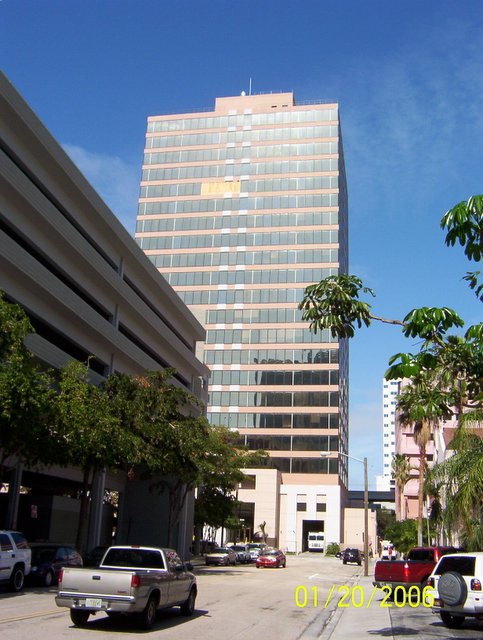
Here is the latest property visit I made. It is a 342,686 sq ft office building in Ft. Lauderdale. The sponsor, as part of the purchase, is selling the underlying lot to an insurance company, so the tenant-in-common investors are just purchasing the building. Very interesting structure and on paper is adding close to $6 million in value.


Sunday, February 05, 2006
Another One...
I just saw another TIC offering with negative leverage. Like the post mentioned below, this deal has a mortgage rate that is expected to be 5.6%, and the cap rate (return) is 4.9%, inclusive of all the fees and reserves of the offering. This apparent economic disadvantage is easily solved. The sponsor has reserved cash to supplement the distribution for the first three years and the mortgage is interest-only for the first three years. Oh, and the growth rate on the Net Operating Income is projected at more than 4% annually. OK. Looks good on paper, but watch that distribution in the fourth year.
I just saw another TIC offering with negative leverage. Like the post mentioned below, this deal has a mortgage rate that is expected to be 5.6%, and the cap rate (return) is 4.9%, inclusive of all the fees and reserves of the offering. This apparent economic disadvantage is easily solved. The sponsor has reserved cash to supplement the distribution for the first three years and the mortgage is interest-only for the first three years. Oh, and the growth rate on the Net Operating Income is projected at more than 4% annually. OK. Looks good on paper, but watch that distribution in the fourth year.
Risk Premium
Where did this go? It has always been overlooked, but it’s about time to revisit the Risk Premium of these illiquid alternative investments and make the reader aware of the returns they should require. Based on investment size and illiquidity alone, the risk premium for real estate securities, in my opinion, requires at least a 300 basis point premium over the comparable US Treasury. Add in deal specific risks and the Risk Premium gets even greater. How many programs are offering returns 400 basis points over their comparable US Treasury? I’m waiting…..
Thursday, February 02, 2006
Cracks in the Armor
Last month I saw my first Tenant in Common offering that had negative leverage. The sponsor was purchasing the property around a 4.9% cap rate (inclusive of all fees) and had debt with an interest rate around 5.7%. Ouch - a 70+ basis point negatvie spread. So why would anyone invest? Make the loan interest-only for the first five years and project annual rental growth rates of around 4% and that pesky negative leverage disappears. Presto! Oh, and hold the property for twelve years.
Last month I saw my first Tenant in Common offering that had negative leverage. The sponsor was purchasing the property around a 4.9% cap rate (inclusive of all fees) and had debt with an interest rate around 5.7%. Ouch - a 70+ basis point negatvie spread. So why would anyone invest? Make the loan interest-only for the first five years and project annual rental growth rates of around 4% and that pesky negative leverage disappears. Presto! Oh, and hold the property for twelve years.
Wednesday, February 01, 2006
Welcome to the Rational Realist. This site will provide comment, insight and analysis on the world of alternative investments, in particular real estate securities and other direct investments. I have close to twenty years experience analyzing investments and am a Chartered Financial Analyst. The site is not meant to provide investment advice. Most posts will be opinion-oriented and most evidence anecdotal. Any facts will be stated as such.
Subscribe to:
Posts (Atom)