Tuesday, April 04, 2017

Retail's Preppy PE Blues

Here is a Bloomberg article that was sent to me on the departure of J. Crew's long-time creative director.  I don't care too much about the fashion loss, but these two paragraphs jumped out at me:
The change brings fresh upheaval to a chain suffering from sputtering sales, heavy debt and a broader shift away from mall-based retail. Same-store sales -- a key measure -- fell 7 percent last year and 8 percent in 2015. The company also has been hobbled by borrowing tied to its 2011 purchase by TPG Capital and Leonard Green & Partners LP.

J. Crew, led by Chief Executive Officer Mickey Drexler, has been trying to turn around its operations by closing stores, cutting costs and streamlining its inventory. The efforts have helped reduce red ink: The company posted net income of $1.1 million in its most recently reported quarter, compared with a loss of $7 million a year earlier.
I italicized the sentence above.  Add J. Crew to the list of retailers potentially ruined by private equity firms.  Mickey Drexler is a retail veteran, which is positive for J. Crew, but the private equity debt expense makes his job tougher.  The fashion industry is difficult enough with changing consumer trends and tastes, without adding the noose of private equity instituted debt.  Of course, the private equity principals paid themselves from the borrowings that now threaten J. Crew, so they don't care. 

Friday, March 31, 2017

Turn Out The Lights

Lightstone Capital Markets announced today, March 31, 2017, that it is terminating the offering of its hotel equity Lightstone Value Plus III and its affiliated mezzanine lending Lightstone Real Estate Income Trust.  Lightstone's letter explaining the offering terminations stated that a combination of (unspecified) factors lead to the decision to stop raising capital in its two public non-traded REITs.  It assured investors that concerns for the capital already invested was not a reason.

Lightstone has never been a capital raising powerhouse.  It was bringing in $10 million to $15 million per month combined in the two REITs on a consistent basis.  By current standards this is a respectable capital inflow, but it is by no means great.  I suspect this slow, expensive raise, was the leading factor in Lightstone's decision to close the two REITs' capital offerings.  Through February 2017, Lightstone Value Plus III had raised $124 million in equity and Lightstone Real Estate Income Trust had raised $73 million.   Let's be clear, real estate companies never stop steady capital inflows regardless of the market outlooks - unless cheaper money is available.  Any notion that Lightstone is halting capital because it cannot find attractive deals is nonsense.  

Separately, Lightstone had told broker dealers for several years that Lightstone Value Plus REIT II, the predecessor REIT to the now-closed Lightstone Value Plus REIT III, was ready for a liquidity event and that it was in advance talks with potential purchasers of the REIT.  It is my opinion that any near-term liquidity event for Lightstone Value Plus REIT II is now unlikely.  Investor capital from a liquidity event no longer has a Lightstone fund in which to reinvest and would leave to other non-Lightstone investments, which is the biggest fear of firms that receive asset management fees, and a disincentive for Lightstone Value Plus II to seek liquidity.   

Tuesday, March 28, 2017

My Retail Obsession

Here is another post on failing retailers.  I can't help it, I find it fascinating.  Last weekend the Financial Times published a long article on the decline of Sears and the shopping mall.  Sears' failures are the result of losing the competitive battle with WalMart and an owner who may have been a hot shot Goldman Sachs financial wunderkid but knew nothing about retail when he bought Sears and has not seemed to learn on the job. 

I find this graphic from the article illustrative of the problems facing retailers:


The retailers having so much trouble - JC Penney, Macy's, and Sears - have wide exposure in Class B and Class C malls, which are older malls in poorer areas and/or more rural locations.  These are the malls in WalMart territory.  Retailers in Class A malls like Nordstrom and Bloomingdale's are not facing the problems of retailers in the lower grade malls, and you can't tell me that Nordstrom's and Bloomingdale's shoppers are not as active online as those shoppers at Sears, Penney's and Macy's.  How the Class B and Class C malls compete with WalMart and other single-stop discounters, or the sociological and demographic shifts impacting retail and shopping malls, are more important stories than Sears' inept operation since Eddie Lampert acquired it in 2004. 

Wednesday, March 22, 2017

Another PE Retailer Bankruptcy

Bloomberg is reporting that Payless, the discount shoe retailer, is set to file for bankruptcy next week.  Payless was purchased in 2012 by private equity firms Golden Gate Capital and Blum Capital.  I wrote last week about the disaster private equity owners have been to retailers.

The Moody Merger Hot Mess

I thought this blog was the place for sharp analysis in a snark covered wrapper regarding alternative investments.  It seems I have some competition from an old industry player.  Robert Stanger & Co. has published some brutal commentary on the American Financial Trust (AFIN) and Retail Centers of America merger, and Brookfield Strategic Real Estate Partners II's advantageous investment into ARC Hospitality.  Last week Stanger shredded the cockamamie proposed merger of Moody National REIT II's (Moody's II) proposal to merge with Moody National REIT I (Moody I).  Here is the link (via the DI Wire) to read the entire Stanger commentary on the Moody merger.

The merger was originally announced last September.  It makes no sense for me to resummairze the merger because Stanger's report is excellent. The following is Stanger's summary of the merger and the fees involved with it:

So now comes Moody II with an offer to merge with Moody I by issuing shares of Moody II or, subject to an aggregate limit of 50%, cash for each Moody I share. The stated range of nominal consideration to the Moody I shareholders is $10.25 to $11.00 per share, depending upon the level of transaction costs incurred in the deal. While the structure is unusual to say the least, the transaction cannibalizes the inherent value of Moody I investors’ shares by burdening that value with up to $21.8 million of transaction costs. We estimate these transaction costs represent 13.8% of the aggregate Moody I equity value.
To take another bite out of the Moody I investors, Moody II will be denominating the value of the shares of Moody II at $25.00 per share rather than the pro forma Combined Net Investment Amount of approximately $23.00. By our calculation, the aggregate cost and discount related to the fees and possibly overstated stock price ascribed to Moody II in the merger totals about $29.3 million, or about 19% of the pre-transaction equity value of Moody I.
Looked at from a different perspective, the investors in Moody I are incurring up to $21.8 mil- lion of transaction costs to merge with a portfolio comprised of two hotel properties and one note purchased at an aggregate cost of $113 million – a merger which at best will provide liquidity to half of the Moody I investors.
Stanger goes on to detail Moody's II's skirting of the intent of FINRA 15-02, the lack of disclosure to investors regarding financial details of the merger, lack of fee disclosure, and how Moody's is paying financial advisors to recommend clients select the non-cash merger option of taking shares in Moody's II rather than cashing out. 

Moody's II has raised $91.7 million of investor equity through February 2017.   It has been raising equity capital for two years and only owns two hotel properties and a note receivable.  Moody's I closed its offering in early 2015, raised $133 million, and owns twelve hotel properties.  

I will add two points that I did not read in the Stanger report.  First, by merging Moody's I into Moody's II, Moody's I investors now own shares in a non-traded REIT that is still raising money.  Moody's II can extend its offer period another three years.  This is not a liquidity event, but some kind of twisted non-traded REIT hell where investors in a closed REIT get stuck in a capital raising reset.  

Second, if half the Moody's I investors select the cash option, where will Moody's II come up with the cash?  At a $133 million equity raise for Moody's I, that is at least $66 million Moody's II has to find to cash out the 50% limit.  Add this to all the fees Moody's is paying itself, and it is likely Moody's II will have to borrow money to cash out investors and pay fees.  (Moody's II had about $12 million in cash at September 30, 2016, the date of its most recent financial statement.  It is raising about $7 million a month in new equity.)

I urge you to read the Stanger commentary

Tuesday, March 21, 2017

Dark Corners

There are some strange stories on financial websites and message boards.  I found an odd post on a bizarre transaction on the Seeking Alpha website.  It discusses a transaction between Presidential REIT and First Capital Real Estate Trust, Inc., where First Capital entered into an "interest contribution agreement" with Presidential on a 23-acre development site in Sacramento.  First Capital is contributing a 66% interest in its 92% ownership interest in the development project in exchange for 37,281,000 convertible Operating Partnership units.   The author of the Seeking Alpha article somehow thought this transaction added value to Presidential, and allowed investors to buy Presidential's stock at a 39% discount.

A non-cash transaction involving a development property and operating partnership units in a REIT with a market capitalization of $4 million is suspect.  The story then goes from suspect to downright dodgy.  The Seeking Alpha article makes no mention that as part of the "interest contribution agreement" Presidential is assuming 66% of First Capital's liabilities on the project, and that the project with the supposed hidden value is in default on its mortgage.  The Sacramento property is subject to a mortgage with a $20 million principal, but the mortgage is in default due to First Capital's inability make principal and accrued interest payments, and First Capital now owes $42 million on the mortgage.  First Capital has received a "Notice of Default and Election to Sell under Deed of Trust" from its lender.  

(Think about it, the original mortgage value of $20 million requires a $42 million payment, or more than double the principal outstanding.  This is due to accrued interest that gets paid at loan maturity along with principal, and not in regular interest payments.  To accrue this much interest, even at an assumed high interest rate, would require years of accrual.  This loan had to have been extended repeatedly, which shows the poor management at First Capital.  This is staggering.)

If the astute Seeking Alpha analyst/author determined its supposed $23 million net value for the development project with the outstanding $20 million principal, the addition of $22 million eliminates all value.  The analyst should have read First Capital's filings.  This whole transaction is nuts.  It is as if both sides are trying to take advantage of one another - Presidential trying to buy assets with worthless operating partnership units as currency, and First Capital passing off a near underwater property with a defaulted mortgage to a dupe.  And even if the analyst incorporated the $42 million mortgage into his valuation, how is Presidential, with a market cap of less than $5 million, going to repay this mortgage? 

I wrote about First Capital last fall.  It has not filed financial statements since the second quarter of 2015.   It is a public company; it has to file financial statements.  Its reverse merger with Presidential, although announced in July 2016, has not happened, and instead it is entering into non-cash deals with Presidential and others.  This company is toxic.  Oh, and it is still trying to raise money from investors in private placements.

Monday, March 20, 2017

Carter Validus' Whisper Sale

On March 3, 2017, Reuters published an exclusive article stating that public, non-traded REIT Carter Validus was up for sale at a price tag of more than $3.5 billion.  The article cited unnamed people "familiar with the matter."  Carter Validus has not made any public filings to confirm or deny the article.  This would be great news if Carter Validus liquidates.  The Reuters article reads as though Carter Validus is shopping its data center properties and its health care properties to separate buyers.

I am skeptical of any transaction until I see a confirmation from Carter Validus.  It hired Goldman Sachs in 2015 to find liquidity but nothing happened.  Carter Validus is an established, fully invested REIT that continues to over pay its distribution.  According to its third quarter 10-Q, the REIT had overpaid its distributions in 2015 and for the first nine months of 2016.  For the first nine months of 2016 distributions were $96 million and modified funds from operation (MFFO) were $85.9 million.  (Carter Validus added a risk disclosure at the end of its third quarter 10-Q regarding the over payment of its distribution.) 

In addition to its distribution over payment, the REIT has about a third of its nearly $1 billion of debt in variable rate borrowings.  Interest rates have increased since November.  The thirty-day LIBOR rates have increased about 50 basis points over this time.  Carter Validus' third quarter 10-Q states that a 50 basis point increase in interest rates would increase the REIT's interest expense rate by $1.5 million per year.  The increased interest expense lowers amounts available for distribution.   The REIT has another $542 million of variable rate debt that is currently fixed using interest rate hedges.  These hedges expire between late-2017 and mid-2020.  If the hedged debt is not retired before the hedges expire, the REIT will have to buy more expense hedges to keep rates fixed or pay higher interest expense.

I state the last two items because under certain liquidation scenarios Carter Validus is going to have to deal with its distribution over payment.  Any buyer of the REIT will lower the current distribution.   As interest rates have increased capitalization rates have increased, too.  Cap rates and valuation are inversely related, so an increase in cap rates means a lower valuation for an underlying property.  (I have not seen an article on cap rates increasing, but have talked to real estate professionals who told me that cap rates have increased, but not at the pace of interest rates.)

I hope Carter Validus has a buyer(s) and executes a transaction soon. If Carter Validus liquidates its portfolio in two more more transactions, capital is going to come back in multiple payments, not one big lump sum payment.  

Tuesday, March 14, 2017

Retail's Other Problem

On-line shopping has hurt retailers.  In 2016, ecommerce sales were estimated at $1.9 trillion, and are expected to double to over $4 trillion by 2020.  In shopping malls, anchor tenants are closing and the surrounding retailers are impacted by fewer shoppers.  I am reading this morning that Neiman Marcus is looking to sell itself because of a sales slump.  Its same store sales fell 6.8% for the quarter ending January 28.  Neiman Marcus has a bigger problem than declining sales, and this line from the Bloomberg article linked to above tells it all:
The company has about $4.9 billion of debt outstanding, some of it tied to its $6 billion acquisition in 2013 led by Ares Management LLC and the Canada Pension Plan Investment Board. They bought the chain from TPG Capital and Warburg Pincus LLC, which acquired Neiman Marcus for about $5 billion in a 2005 leveraged buyout.
Neiman Marcus is over 80% leveraged, and that is based on its 2013 purchase price.  It has $4.9 billion of debt outstanding and S&P recently said Neiman Marcus' debt is unsustainable.  The private equity firms that acquired trophy retailers with extreme debt levels give firms like Neiman Marcus little room to operate in a slump.  Neiman Marcus' capital issue is now more pressing than its sales decline, and its likely taking more of management time than thinking of creative ways to attract new customers.  The Bloomberg article says that one Neiman Marcus bond issue is trading at $.49 on the dollar, a price that says the market expects default.   Private equity firms have ruined many retailers, restraining management and growth because of demands to service debt.

Wednesday, February 08, 2017

DI Wire's Click-Bait

Today's headline in the DI Wire's daily news and public relations passing-as-news email is wrong.  The headline states:  "AR Global's BDCA Appoints Two New Board Members."   AR Global is no longer involved with BDCA.  As of November 1, 2016, an affiliate of Benefit Street acquired BDCA's advisor from AR Global.  I guess any mention of AR Global in a headline is good for solid click-bait.  The DI Wire article is correct for those that bothered to read past the email's error.

Tuesday, February 07, 2017

The T Share Scourge

I hate T Shares.  They were a preemptive answer to a problem that did not exist.  T Shares were forced upon the non-traded alternative investment industry by sponsors scared of a pending statement rule that would require them to show investors the price of their investment net of initial fees.  The thinking was that if investors realized how much the up front costs were for non-traded REITs and business development companies (BDCs) they would never buy a non-traded product.  For example, a $10.00 per share investment with 10% in initial offer costs would show $9.00 on the first client statement, or an implied immediate 10% loss.  The initial costs of these investments is already well disclosed to investors, as well as the net investment amount, regardless whether the statement reads $9.00 or $10.00 per share.

There was a consensus that a statement value showing a decline of 4% to 6% would be acceptable, but much lower than this would raise unwanted questions and concerns.  Therefore a statement value of $9.40 or $9.60 per share was thought OK, but a value of $9.00 per share would invite investor wrath.  I do not think investors were asked their opinion.

Of course, the fees must still be paid.  A financial advisor would never sell a non-traded REIT or BDC without full commissions, right?  A sponsor must make its immediate profit, right?  T Shares led to the financial gymnastics of reclassifying, adjusting, and delaying fees to show a high statement value but maintain fees.  Key jargon terms are "above the line" and  "below the line."  Fees paid directly from offering proceeds are "above the line," and fees not paid from offering proceeds are "below the line."  Fees accounted for as "below the line" do not lower the statement value.

In T Shares, the upfront sales commission to financial advisors is reduced to 3%, with an additional 1% paid per year for up to four years, from the traditional 7% commission paid up front.  Therefore, in a T Share, only 3% of the commission is "above the line" and not deducted from the statement value, a big savings.  The 1% ongoing commission typically has a euphemism like "Distribution Supervision Fee" or some other similar nonsensical term.  How exactly does a financial advisor supervise a distribution?  If financial advisors actually supervised distributions, distributions would increase every year.

I have seen investments that now classify organization fees and expenses, typically .50% to 2.0% or more of the investment price and incurred and paid at the earliest stages of the investment, as "below the line" ongoing expenses that no longer count them against the statement value.  Sponsors, in many cases, have lowered their marketing fees (dealer manager fees) by .25% to 1.00%, which are "above the line" expenses, so the lower fees boost statement values.  Many sponsors have elected to adjust their acquisition and finance fees, which are "below the line" expenses, to offset lower dealer manager fees.  One sponsor, when it introduced its product's T Shares in 2016, lowered dealer manager fees by 1.0%, but raised its acquisition fees by 1.10%.  This adjustment of fees increased the combined above and below line fees by more than 1.50%, after leverage.

Here is where the T Shares go from farcical to putrid.  The 1% Distribution Supervision Fee is paid from a REIT's or BDC's on going cash flow, or monies available for distribution, and lowers a T Share investor's distribution by about 1% per year.  For example, a REIT that pays a 6.5% distribution on its traditional Class A shares pays a 5.5% distribution on its Class T shares.

T Shares are counter-intuitive, they have lower up front costs, therefore a higher statement value, and more money is invested rather than paid in fees, which are positives for investors.  But their distribution is lower than a share class with a higher load due to shifting and reclassification of fees. It is a Stranger Things' Upside Down World.

Financial advisors have never been the largest voice for lower fees.  As long as they got paid and believed the investment solid, they have been willing to overlook high fee investments.  Most financial advisors are not going to stand for having their clients paid less in distributions, having their commissions cut, while sponsors maintain or increase their fees.  There no great shock that sales of non-traded REITs and BDCs were so bad last year.

There have been other challenges that have helped slow the sale of non-traded REITs and BDCs: the looming DOL changes (I am not going to open that discussion here), the lack of liquidity events, the collapse of the Realty Capital sales empire, and the sharp declines in BDC NAVs that started in late 2014 and provided acute proof that high yield BDCs were high yield for a reason.  But to me to me, the largest sales impediment was the rush to T Shares and the tepid response due to their flawed structure.

Financial advisors won't continue to sell a product where their clients get a lower return and get they paid less.   Low commissions are here to stay, so its time to create a better product structure.  If commissions are lowered, distributions to investors must increase.  The sponsors that understand this simple financial physics and design products to address it are going to see inflows of capital.  The industry needs products with tangible and attainable incentive compensation for sponsors, after providing returns to investors, even if it means higher long-term sponsor compensation.  Sponsors that cling to high acquisition fees or high asset management fees that provide no incentive except to overpay for assets will lose.  Until sponsors and broker dealers address their T Share problem, expect sales to stay moribund.

Wednesday, October 19, 2016

Confluene of Crap

This blog has tracked UDF IV's lack of financial statements, which culminated in yesterday's de-listing announcement for UDF IV due to its inability to file financial statements.  Well, UDF IV is not the only non-traded REIT with a failure to file financial statements problem.  A small public REIT, First Capital Real Estate Trust, which was formerly United Realty Trust, has not filed financial statements since the 2015 second quarter 10-Q.  In September 2015, United Realty's former sponsor, advisor, property manager, and principal entered into a sales agreement with First Capital Real Estate Investments, LLC, in a deal that provided cash and a consulting contract to United Realty's former principal.  The REIT changed its advisor and changed its name to First Capital Real Estate Trust.

In October of 2015, First Capital Real Estate Trust fired its auditor, Ernst & Young, and has not filed an 8-K disclosing a replacement auditor.  The REIT has not filed any financial statements since the transaction with First Capital, and it has been through three CFOs since August 2015, with the last leaving in early April of this year.

There is much more related to First Capital Real Estate Trust.  Take thirty minutes to read through First Capital's public flings for the past year to get your Halloween fright.  You'll need to reference United Realty's 2014 10-K to partially grasp, or at least put in some jaw-dropping context, what the heck First Capital did in September with its Brooklyn, New York, Tilden Avenue property. 

Here is another Halloween scare:  I read a "due diligence" report, dated late August 2016, on First Capital Real Estate Investment's new private debt offering that failed to mention any of the issues at the REIT.  Maybe it is just me, but I'd think any broker dealer reading a "due diligence" report would find it material that an affiliated flagship REIT had no auditor, had no CFO while churning through three CFOs in less than a year, and had not filed any financial statements since 2Q 2015.  Thanks for the heads-up, Bozo. 

Did Not See That Coming

UDF IV missed its Tuesday (October 17, 2016) deadline to file its financial statements to avoid Nasdaq de-listing, and Nasdaq notified UDF IV that it will de-list UDF IV's shares.  In a press release yesterday, October 18, 2016, UDF IV gave no specifics on when it plans to release its updated financial statements.  In addition, UDF IV notified investors that the SEC provided a Wells Notice to the REIT and certain individuals associated with the REIT, where the U.S. Securities and Exchange Commission's ("SEC") Division of Enforcement made a preliminary determination to recommend that the SEC file an enforcement action alleging violations of certain provision of the Securities Act of 1933 and the Securities Exchange Act of 1934.

The SEC's allegations were not released.  None of this news comes as a big surprise.  It is an understatement to say this is a serious situation. 

Tuesday, September 06, 2016

High Rent Blight

Here are several articles and blog posts on high rent blight (here, here, here, and here).  High rent blight is when landlords in fancy or trendy areas increase rents to a level where many businesses can no longer afford stay in their current location.  Businesses that face large rent increases must choose to move to cheaper parts of town or close entirely.  The landlord then elects to keep a space vacant for an extended period until it can find a tenant willing to pay the rent, leading to prolonged periods of empty retail space in otherwise vibrant neighborhoods.

I have noticed this high rent blight, but did not know it was a real issue or had a name.  I wondered why there was so much vacant space in places like SoHo, La Jolla, Beverly Hills and West Los Angeles (I noticed this on S. Robertson Blvd.), and San Francisco.  Initially, I thought the vacancies were a leading indicator of an economic slowdown, but it is actually revealing the opposite.  I know there is more to high rent blight than greedy landlords or landlords playing a tax game, and one blanket term does not apply to all buildings.  But it does make walking around high rent blighted neighborhoods feel disconcerting, it is as if they are downtrodden for some unknown reason. 

Landlords should be careful.  Trends move fast and people do not linger on a half empty street, especially if an open door way becomes a permanent homeless shelter.

Tuesday, August 30, 2016

Speed Bump

In a filing late Friday afternoon, UDF IV disclosed that it has asked the Nasdaq Panel for an extension to avoid delisting.  Nasdaq had given UDF until September 12, 2016, to file its 2015 audited financial statements along with 2016's first and second quarter financial statements, which I noted here.  According to Friday's statement, UDF IV's auditor needs more time to finish its work.  I do not think this is good news for UDF IV.

UDF IV's entire statement is below, with bold added to the section pertaining to the extension request:

GRAPEVINE, Texas, August 26, 2016 – As previously announced, United Development Funding IV  (“UDF IV” or the “Trust”) (NASDAQ: UDF) has not filed with the U.S. Securities and Exchange Commission (the “SEC”) its Annual Report on Form 10-K for the fiscal year ended December 31, 2015 or its Quarterly Report on Form 10-Q for the first quarter of fiscal 2016. The Trust also has not filed its Quarterly Report on Form 10-Q for the quarter ended June 30, 2016. Nasdaq Listing Rule 5250(c)(1) requires the timely filing of periodic reports with the SEC, and therefore, pursuant to the procedures of the Listing Qualifications Department of The NASDAQ Stock Market LLC (“Nasdaq”), the Trust received formal notice from the staff of the Listing Qualifications Department, announced herein pursuant to Nasdaq Listing Rule 5810(b), indicating that because the Trust failed to timely file its Quarterly Report on Form 10-Q for the quarter ended June 30, 2016, the Nasdaq Hearings Panel (the “Nasdaq Panel”) will consider the additional deficiency in connection with the Trust’s request for the continued listing of its securities on Nasdaq.

As previously announced, UDF IV attended a hearing before the Nasdaq Panel, which subsequently granted the Trust’s request for continued listing on Nasdaq, subject to the Trust evidencing compliance with Nasdaq Listing Rule 5250(c)(1) and with all other applicable requirements for continued listing on Nasdaq by September 12, 2016.

The Trust engaged auditors on June 8, 2016, and the audit process began immediately. After recent conversations with its new auditors regarding the expected filing date for its Annual Report on Form 10-K for the fiscal year ended December 31, 2015 and the Quarterly Reports on Form 10-Q for the quarters ended March 31, 2016 and June 30, 2016, respectively (the “Filings”), the Trust notified the Nasdaq Panel that it would need additional time to file all Filings simultaneously. Therefore, the Trust will submit a written request to the Nasdaq Panel for an extension of the September 12, 2016 filing deadline.

Trading in UDF IV’s securities on Nasdaq has been halted since February 18, 2016, and the Trust expects that the trading halt will continue at least until the Trust has become fully current in its periodic filing obligations with the SEC. No assurance can be given regarding the resumption of regular trading of the Trust’s securities on any market.

Tuesday, August 23, 2016

Head Scratcher

I do not understand why New York REIT, Inc. (NYRT) is planning to liquidate.  NYRT is a former non-traded REIT that listed on the New York Stock Exchange in April 2014.  It is associated through management with AR Global.  NYRT has been battling outside institutional investors that opposed NYRT's planned merger with JBG Companies and certain of JBG Companies' private funds.  The merger was cancelled in early August. 

So the JBG Company merger did not happen and NYRT decides its only option is to sell all its properties?  NYRT's second quarter 10-Q states the REIT has $2 billion in assets and nineteen properties.  This Bloomberg article reports on institutional investor skepticism about the planned liquidation, including from WW Investors, the firm that helped end NYRT's merger with JBG Companies.   The asset sale and liquidation plan, like the JBG Companies merger, faces outside resistance as noted by this quote from the Bloomberg article:

Sheila McGrath, an analyst at Evercore ISI, said the New York-based company had better options than the liquidation and that a new board of directors must be installed immediately.
“This is the same board that approved the JBG merger transaction at a significant cost to shareholders,” McGrath wrote in a research note Monday. “The one thing that most institutional investors that we have spoken to support is the recasting of the NYRT board as soon as possible prior to making any final strategic decision.”
 There is plenty of drama yet to come for NYRT.

Monday, August 15, 2016

Crazy Stuff

This is wild story on Bloomberg.  The SEC today suspended a $35 billion company based in Northern Baja California.  Neuromama's stock was halted until August 26 “because of concerns regarding the accuracy and adequacy of information in the marketplace about, among other things, the identity of the persons in control of the company’s operations and management, false statements to company shareholders and/or potential investors that the company has an application pending for listing on the NASDAQ Stock Market, and potentially manipulative transactions in the company’s stock.”

Neuromama's stock has quadrupled so far in 2016 despite not having filed filed financial statements since 2013, and then it had no revenue.  This section gives no comfort:
Steven Zubkis, who also goes by Steven Schwartzbard, is the marketer behind Neuromama, according to the company’s website. He left prison in August 2010 after being sentenced for five years for defrauding investors, in a $1.8 million scheme through misrepresentations tied to the renovation of a Las Vegas casino. The Ukrainian immigrant was sued by the SEC in the 1990s for orchestrating a $12 million penny stock scam. He was ordered to pay more than $21.6 million in disgorgement and penalties for selling unregistered securities from 1993 to 1996.
In what business does a company named Neuromama operate?  The Bloomberg article states that it "operates in a broad range of businesses: a search engine, licensing “heavy ion fusion technology patents,” and Cirque-du-Soleil-style performances in Tijuana, to name just a few."  Well, that explains things.

Blackstone's Non-Traded REIT

Here is a Bloomberg article on Blackstone's new $5 billion non-traded REIT - $4 billion initial offering with $1 billion of distribution reinvestment - which was filed last week with the SEC.  The article states that the new REIT will address transparency issues that have plagued other non-traded REITs.  The article does not state how the Blackstone non-traded REIT is more transparent than other non-traded REITs.  Unsubstantiated comments like this annoy me.  Most non-traded REITs have decent transparency, you just have to take the time to read filings.  I am not sure what Blackstone plans to disclose that other REITs do not.

The Bloomberg article has a positive quote from a Green Street Advisors managing director:
“Historically, the fee load has been pretty significant for retail investors to get into these vehicles,” said Dirk Aulabaugh, a managing director in the advisory and consulting unit of Green Street Advisors LLC, a Newport Beach, California-based real estate research firm. Blackstone’s new fund appears to be “better aligned than what has historically been the case in the nontraded REIT space, and I think investors are going to welcome that, and they’ll be successful in raising capital along those lines.”
Like the transparency issue, the article implies through the quote above that the Blackstone non-traded REIT has a better fee structure than other non-traded REITs, but it offers no specific comparisons.  I guess I am going to have to read through the dang filing to find out for myself.

Friday, August 12, 2016

D'oh!

A DI Wire headline today states that "MVP REIT Reports 94 Percent Increase In Year-Over-Year Revenues."  Amazing! Stupendous! Fantastic! Misleading!  The REIT was raising and investing money over this period, so a 94% revenue increase needs more context.  A REIT raising equity and borrowing money to buy properties better be increasing revenue. Year-over-year financial performance for any investment in the midst of raising and investing capital is non-comparable.

Let's take a look at some of MVP REIT's other year-over-year financial points of interest from the same financial statement along with sample headlines:
  • Assets increased 59% from $81 million to $129 million.  "MVP REIT's Total Asset Skyrocket 59%"
  • Debt increased 75% from $25 million to $44 million.  "Burdened:  MVP REIT's Debt Leaps 75%"
  • MVP's Net Loss for the six months ended June 30, 2016 was ($2,131,000) compared to a Net loss of ($1,572,000) for the six months ended June 30, 2015, a drop of 39%.  "Oops, MVP REIT's Net Loss Moves In Wrong Direction, Dropping 39%"
  • MVP's Cash From Operations for the six months ended June 30, 2016 was ($1,159,000) compared to Cash From Operations of ($1,347,000) for the six months ended June 30, 2015, an improvement of 14%.  "MVP REIT Slows Hemorrhage of Operating Cash"
All the headlines are right, and all are misleading.  Only when MVP REIT has several quarters of fully invested operations will period-over-period comparisons be relevant.  One point that is true about MVP REIT, and that is not obfuscation, is that it is a small REIT.  It only raised $97 million in equity in its offering and has $129 million in total assets.

Thursday, August 11, 2016

Looking Through The Rearview Mirror

I read last week that FINRA has launched an investigation into non-traded business development companies (BDCs).  FINRA is late to this issue, like about three years too late.  Non-traded BDC sales are down a staggering 63% through the first seven months of 2016 compared to the same period in 2015.  The drop can be attributed, in part, to the closing of Franklin Square's FSIC III and CNL's Corporate Capital Trust, two of the top selling non-traded BDCs, and the tepid reception of their respective follow-on offerings.  The decline in sales is also related to the lower NAVs reported by many BDCs over the past year and a half, which served to spook clients and financial advisors.  Non-traded BDCs are required to value their portfolios quarterly, or more frequently if their NAVs move outside pricing bands, and non-traded BDCs have shown they are not immune to market forces.

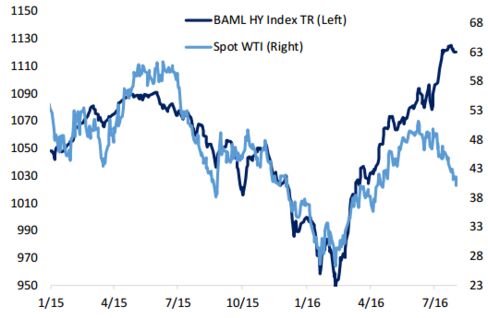
The drop in oil prices that started in the second half of 2014 was felt across high yield markets, and therefore by non-traded BDCs.  The oil and gas sector is heavily represented in the high yield debt sector, and the graph I presented my previous post illustrates how correlated oil prices and the high yield markets were until earlier this year.

BDCs are a structure, not an asset class.  Most non-BDCs operate in the large non-bank financing market, primarily making a variety of loans to small and medium sized companies.  Companies that borrow from BDCs and other non-bank lenders are generally growing companies that do not have banking relationships or cannot get bank financing, and therefore do not have investment grade credit ratings, if they have a rating at all.  This is a high yield market and comes with all the risk of high yield investing.

I have seen various numbers related to the size of the non-bank capital market, but the smallest figure I have seen is $1 trillion and the largest over $50 trillion.  This is a legitimate market that is not going away anytime soon.  Non-traded BDCs are a small part of this huge market.

Wednesday, August 03, 2016

Oil and High Yield Debt

Here is a good Bloomberg article on the rebound in high yield debt and the oil markets.  For much of the past year and a half the price of oil and high yield debt have moved together.  The latest drop in oil prices has been a solo move, as high yield debt has not followed the oil market down.  The following chart from the article shows the performance of oil and high yield debt since the start of 2015:


High yield debt market moved with oil because so many recent issuers of high yield debt were oil and gas companies.   A May 31, 2016, report by the law firm Haynes & Booth states that there have been 81 oil and gas bankruptcies since the start of 2015.

The Bloomberg article takes a closer examination of the high yield debt and oil markets.  When just the high yield debt of energy companies is compared to the price of oil, the performance is strikingly similar.  While the overall high yield market may have separated from oil, energy high yield debt is following the price of oil down.

Update:  As of August 3, 2016, the number of oil and gas bankruptcies since the start of 2015 is now up to 85.

Friday, July 29, 2016

Posting Again

It is time to start reposting.  I never formally stopped writing this blog so I am not formally restarting it.  There is a mealy-mouthed cop-out if ever there was one.

The primary reason I decided to restart posting is the DI Wire.  I have been getting its daily updates on the Direct Investment (DI) industry for a year or more and still have not figured out its mission.  Is it news?  Paid advertisement?  A mixture of both?  The best I can figure the DI Wire is mostly the PR Wire.  The tipping point for me was earlier week when a headline announced that Benefit Street was to acquire Business Development Corporation of America (BDCA).  Wrong.  As subsidiary of Benefit Street is acquiring BDCA's advisor from AR Global, and it is not acquiring BDCA.  The headline, which has not been corrected, implied a liquidity event for BDCA investors.  Wrong.  BDCA investors will have a new investment manager, not liquidity.  Big, big difference.

Of course I will continue to read the DI Wire, I love to read stories about direct investment sponsors hiring wholesalers or random acquisitions in line with investment objectives.

The Clock Is Ticking...

On July 25, 2016, UDF IV received written notice from Nasdaq Hearings Panel that Nasdaq Global Select Market will continue to list UDF IV stock.  UDF IV's stock is currently halted.  The Nasdaq decision is contingent upon UDF IV meeting certain listing requirements, in particular it has to file with the SEC 2016's first and second quarter financial statements and 2015's audited financial statements by September 12, 2016.

UDF IV's auditor resigned last November.  A new auditor, EisnerAmper, LLP, was announced on June 8, 2016, which was good news for the mortgage REIT.  The new auditor is presumably working to complete UDF IV's financial statements before the September deadline.  I expect ugly results when and if UDF IV's stock is allowed to resume trading as investors will rush to exit.  Audited financial statements or not, UDF IV remains under investigation by the FBI and SEC and is in default on a term loan that had $28.5 million outstanding as of May 23, 2016.  The following passage from UDF IV's 8-K filing describing the default shows the level of financial restrictions it faces as a result of the default:
The Trust (UDF IV) is required to use a portion of its future available cash flow to pay transaction expenses, interest due under the Loan, and principal. The Trust has agreed to provide certain financial reporting to the Lenders and it has agreed to suspend distributions to its shareholders during the Forbearance Period. The Trust also agreed not to originate new mortgage loans, incur additional debt, grant additional or substitute collateral to any other lender, or dispose of assets without first obtaining the consent of the Lenders.
 I want UDF IV to resolve its issues.  Its financial statements are at the top of my summer reading list.

Wednesday, April 29, 2015

Good Advice

Here is a Bloomberg article that quotes Colony Capital's Thomas Barrack, Jr.   Mr. Barrack provides some smart, basic advice, but advice that few people will follow.  This passage is a warning:
“Everybody is outside of their own asset class,” Barrack said in a Bloomberg Television interview Tuesday with Erik Schatzker and Stephanie Ruhle at the Milken Institute Global Conference in Beverly Hills, California. “When amateurs enter the marketplace for all of this, you are going to get an abundance of something and it is usually not good.”

Central banks globally have pushed investors into higher-yielding assets by reducing interest rates and purchasing bonds. The Standard & Poor’s 500 Index reached an all-time high on Friday and sovereign debt in Europe is trading at negative yields.

“Institutional investors that are in this endless search for yield are ignoring the risk peril of all the consequences of those things,” he said.
And here is some more:
To protect themselves from possible future losses, real estate investors should look for “equity-type returns” in the capital stack, Barrack said during the panel discussion.

“Floating debt can choke and kill you quickly,” he said.
The article is about real estate investors, but you can substitute nearly any asset class that throws of yield and uses low cost leverage to boost returns. 

InvenTrust

Inland American changed its name to InvenTrust Properties Corp on April 16, 2015.  I would have posted earlier but I am still laughing at this nonsense name.  Inland needs to invent some equity for Inland American investors rather than waste time and money thinking of a made-up name.   The new logo is cool, although I am not sure what it signifies.


InvenTrust's spin-off of Xenia Hotels and Resorts (XHR) has held up well in the market since its listing in February.  It has traded over $22 per share since mid-March.  Inland has had more good news, as its latest non-traded REIT, Inland Real Estate Income Trust, raised over $88 million in March, placing it third out of all non-traded REITs in sales.  Not too shabby.

Friday, March 27, 2015

Tedious

The lazy reporting on non-traded REITs is getting tedious.  Few journalists that write articles about non-traded REITs fully understand them, and it shows.  The latest installment is from the March 24, 2015, Wall Street Journal, in an article titled "Property Investors' Latest Horror: Zombie REITs."  The article focuses on two pre-crash REITs, and not all the liquidity events over the past two years.  The article's focus was Inland American and CNL Lifestyle, two REITs I have recently posted about.  There is no way to spin the poor performance of these two REITs, but they are not the entire market, and their struggles are not new news. 

The article states that the value of Inland American's holdings has plunged 60%.  Wrong.  This is based on the $10.00 per share price that investors paid for their shares and the recently announced $4.00 per share value.  The difference between the original $10.00 per share and current estimate of $4.00 per share is indeed 60%, but it excludes the value of the Xenia Hotels & Resorts (XHR) spin-off that all Inland American investors received.  I figure the listing of XHR was worth approximately $2.80 per share to Inland American investors, or 28% or their original investment (and XHR stock has gone up since its listing).  The article mentions XHR, but not the amount returned to investors.  The amount investors received in XHR needs to be added to Inland American's remaining value.  Inland American still has its issues and investors are still at a loss, but the XHR listing was a major event.

The article further states (my emphasis):
Fundraising by nontraded REITs has now cooled. The funds pulled in about $15 billion in 2014, down by a quarter from 2013, in part because the funds returned just $12.9 billion of investors’ original capital last year, down from $17.2 billion in the previous year.
My own research showed $13.5 billion of original equity experienced liquidity events in 2014, not $12.9 billion.  If you use the WSJ numbers, in two years there was over $30 billion of liquidity.  If you look back at the lack of liquidity in the '80s, '90s, and '00s, $30 billion of capital returned to investors in a two-year span is stunning.

(There is more than a small irony that the article complains about 2014's drop in fund raising for non-traded REITs due to the decline in liquidity events.  Selling a REIT upon its liquidity event to reinvest in another non-traded REIT is a story in itself and a bigger industry-wide issue than two well-known, struggling REITs.)

Journalists and business publications have to get better covering and understanding non-traded REITs (and their sort of brethren business development companies).  These investments have raised billions since 2008, and to sound alarms and recyle old themes without addressing current issues is not helping investors.  The only thing missing from this article was as a Leo Wells reference.

Tuesday, March 24, 2015

Return for Risk?

As a follow-up to my post yesterday about interval funds, I encourage you to click through to view the portfolio for Ladenburg Thalmann's Alternative Strategies Fund (LTAFX).  When you finish picking up your jaw, click here to see LTAFX's returns and determine for yourself whether investors have been properly compensated (through high returns) given the risk of some of the interval fund's holdings. 

Oil Storage Problem

Bloomberg has an article and animated video on its website that present a scenario where oil could go to $20 a barrel or lower if oil storage reaches capacity.  The article is full of hypothetical situations, but it reinforces my feeling that no one knows where the price of oil is headed.

Monday, March 23, 2015

High Priced Mediocracy

Interval funds - generally, continuously offered closed-end funds - give investors a chance to invest in multiple alternative investments they may not otherwise qualify for directly.  I am specifically discussing interval funds that focus on acquiring interests in business development companies, public REITs, private REITs, private equity real estate funds, private placements, and public, non-traded REITs.  These interval funds are similar to mutual funds, so suitability requirements are much lower than a direct investment into one of the non-traded investments owned by the interval fund. 

My knocks on interval funds are fees and performance.  Interval funds are funds-of-funds.  This means there are two layers of fees - one at the interval fund level and one at the underlying investment fund level.  The combined annual expenses can run three percent to five percent of total assets, which is a big hurdle for asset classes and investments - real estate and business development companies - that are historically income oriented, not growth focused.  Funds-of-funds will have average performance, as top performing funds' results are offset by the results from poor performing funds.  Over the long-term, for most investors, I don't believe the portfolio benefits of an interval fund - diversification and lower volatility - outweigh the performance issue, which is inherent because of interval funds' structures, and diminished further by their high fees.

Thursday, March 19, 2015

Growing Glut

I am fascinated by the drop in oil prices.  No one predicted the price drop of the past six months.  No one knows if oil prices are going to $80 a barrel or $20 a barrel.  (There are guesses at both ends of the spectrum, so some analyst will be able to claim prescience.)  The attached Bloomberg article and the chart below are from last week but give an indication of where prices are likely to go, at least in the near term.


Friday, March 13, 2015

Bad Guess

Last week I guessed at a price of $6.50 per share for CNL Lifestyle's new net asset value.  I was not close, not even in the same county close.  In an 8-K filing on March 10, 2015, CNL Lifestyle disclosed a new NAV estimate of $5.20 per share, down 24% from the $6.85 per share estimate at the end of 2013.  Read the 8-K, the candor of certain statements is jarring, like the following passages that help explain why the REIT's NAV dropped from $6.85 per share to $5.20 in one year:
Based on discussions between Jefferies and more than 150 potential buyers over the course of the last year, the Company has determined that the value of its assets is lower than the NAV per share of common stock as of December 31, 2013 (the “2013 NAV”). This price discovery data was not available in prior valuations and represents the most significant factor in the decrease of the 2014 NAV from the 2013 NAV. 
Another factor driving the reduction of the 2014 NAV was portfolio performance that, in certain instances, did not meet the Company’s, its operators’ or CBRE’s forecasts. 
CNL Lifestyle's investment banker, Jefferies, shopped the REIT and its assets to more than 150 potential buyers and was told that the $6.86 per share price was too high ("price discovery").  In addition, the assumptions (i.e. net operating income, cap rates, etc.) the REIT used to determine value in early 2014 were too optimistic.  This REIT purchased plenty of niche assets during a real estate boom, so you can't play revisionist today, but a near halving of value is still ugly.

Thursday, March 05, 2015

Wrong On Many Levels

I am hearing some crazy things about American Realty Capital Properties (ARCP), Cole, and RCS Capital (RCAP).  The rumors and finger pointing are flying around so fast someone is going to lose an eye.  Then I read a blog post on an advisor rumor website (I am not going to link to it) that is so wrong it would be laughable if it was not scary.  The post is essentially long quotes from several broker dealer analysts upset by changes at Cole Capital.  The problem is that the article flips back-and-forth, confusing ARCP, which owns Cole Capital, and RCAP, which owns broker dealers and distributes AR Capital-sponsored alternative investments, and treats the two companies as one entity.  If we have learned anything over the past four months it is that ARCP (and Cole) and RCAP are separate companies.  If you are going to spread rumors, at least get the companies straight.

Tuesday, March 03, 2015

Head's Up

CNL Lifestyle REIT announced (warned) today that it is disclosing its net asset value per share on March 10, 2014.  I can hardly wait.  Lifestyle's NAV last year was $6.85 per share.  In 2014, Lifestyle sold its golf properties and used most of the proceeds to pay off mortgage debt related to the golf properties and pay down the REIT's line of credit.  Lifestyle has not returned any capital to investors from property sales.  Lifestyle is still planning on completing its liquidation by December 31, 2015, according to its third quarter 2014 10-Q.  At what share price do we set the over/under for the new NAV?   I'll guess $6.50 per share.

Monday, March 02, 2015

The Wait Is Finally Over

American Realty Capital Properties, Inc. (ARCP) filed its restated financial statements this morning, which stem from the October 29, 2014, disclosure of accounting errors .  The restatement includes the first two quarters of 2014, and full years 2013, 2012, and 2011.  According to this Bloomberg article, which quotes a JP Morgan analyst, it does not appear that any bigger issues emerged from the restatements.  The specter of some undisclosed issue at ARCP was the concern of most people who follow the non-traded REIT industry.  The restatement did result in ARCP reporting an increased loss and lower adjusted funds from operations for 2013. 

Friday, February 27, 2015

Not Dead - Unlike Inland American

My blogging hiatus is over.  There was no reason for the lack of posts other than more pressing work.  I won't predict the frequency of future posts, but I expect more posts than there have been recently.

Here is Bruce Kelly's article on Inland American's new Net Asset Value of $4.00 per share.  I need to dive further into this calculation.  My quick takeaway is that despite plenty of asset sales over the past two years, the new, lower NAV per share primarily reflects this year's spin-off of Inland American's remaining hotel assets. 

In 2014, Inland American sold $1.1 billion of hotel properties to NorthStar and $2 billion of properties overall, but didn't return any capital to investors.  In 2013, Inland American closed a portion of a $2.2 billion property sale to various American Realty Capital entities, the balance of which closed in 2014.  I figure Inland American sold over $3 billion of properties from the middle of 2013 through the end of 2014. 

In February 2015, in a separate transaction from the sales in 2013 and 2014, Inland American completed the spin-off and listing of Xenia Hotels and Resorts (XHR), which Inland American formed in 2014. (Inland American retained 5% of XHR.)  Inland American investors received shares in the new hotel company, and I estimate that the XHR transaction was worth the equivalent of approximately $2.60 per share to an original $10.00 per share Inland American investment.

Inland American's new Net Asset Value (NAV) per share is $4.00, as of February 5, 2014.  Its previous NAV (December 31, 2013) was $6.94 per share.   The drop in NAV reflects - mainly - the XHR spin-off.   The XHR transaction was Inland American's first return of capital event - through the distribution of fully liquid XHR shares to Inland American investors -  with Inland American retaining and retiring debt with the net proceeds from the $3 billion in property sales in 2013 and 2014.  An investor that originally purchased Inland American shares at $10.00 per share have $7.40 per share remaining, based on the estimated listing value $2.60 per share for XHR.  The new $4.00 per share NAV needs to be viewed in relation to the $7.40 per share of remaining offer contribution.

Inland American announced a lower distribution with its new NAV.   The new distribution is $.13 per share, a drop from the previous $.50 per share.  The lower yield partially reflects the XHR spin-off, but it is also a cut in yield.  The yield on the new $4.00 per share NAV is 3.25%, but based on original investment amount, this represents a yield of 1.76% on the $7.40 of remaining original contribution value ($.13 / $7.40).  This should be compared to the previous 5.0% yield ($.50 / $10.00 per share).

I'm no revisionist and won't feign shock that the current $4.00 per share NAV - which is net of the XHR transaction - is less than the original $7.40 per share, or the remaining original offer price.  Inland American acquired the bulk of its properites before real estate prices dropped in the late 2000s.  A drop in value below the original offer price is expected.  Its disingenuous to think that Inland American could have somehow missed the decline in real estate values.  That being said, the cut in annual distribution yield from 5.0% to 1.75% is sharp.

I encourage you to read Inland American's September 22, 2014, 8-K.  It details new incentive compensation for Inland American executives, among other items.  I guess the executives realized that the original compensation, which was subordinate to investors getting a full return of capital plus a preferred return, was unobtainable.  Here is some of the language from the filing:
On September 17, 2014, the board of directors of the Company adopted the following three incentive compensation plans (the “Share Unit Plans”): (1) the Inland American Real Estate Trust, Inc. 2014 Share Unit Plan (the “Retail Plan”), with respect to the Company’s retail business; (2) the Xenia Hotels & Resorts, Inc. 2014 Share Unit Plan (the “Lodging Plan”), with respect to the Company’s lodging business; and (3) the Inland American Communities Group, Inc. 2014 Share Unit Plan (the “Student Housing Plan”), with respect to the Company’s student housing business. Each Share Unit Plan provides for the grant of notional “share unit” awards to eligible participants.
Share Units. Subject to applicable vesting conditions, each share unit represents the right to receive a cash payment, or, to the extent provided in the applicable award agreement, shares of common stock of the Company, Xenia Hotels & Resorts, Inc. (“Xenia”) or Inland American Communities Group, Inc. (“IA Communities”), as applicable, in an amount equal to the fair market value of the share unit on a specified date. Share unit awards will vest and become payable on terms and conditions determined by the plan administrator and set forth in the applicable award agreement, including by reference to certain change in control transactions or specified events resulting in a listing of the applicable entity’s shares on a national securities exchange (including an initial public offering) (“Listing Events”). A “change in control” under the Lodging Plan and the Student Housing Plan includes a change in control of the Company, in addition to a change in control of Xenia or IA Communities, as applicable. A “change in control” under the Retail Plan includes only a change in control of the Company.
For purposes of each Share Unit Plan, the “fair market value” of a share unit will be determined by the board of directors in good faith, and prior to a Listing Event, will be determined by reference to the valuation performed as of December 31, 2013, or such other subsequent similar third party valuation performed to estimate the value of a share unit on a fully diluted basis, using methodologies and assumptions substantially similar to those used in prior valuations.
At the time of the September 2014 filing, the Xenia assets, retail properties, and student housing were the main property types left in Inland American's property portfolio.  It is my opinion that Inland American investors will never get a full return of capital.   Inland American executives, therefore, won't get their originally planned revenue sharing (15% of profits after a return of investor capital plus a 10% annual return), and is the reason for the new incentive compensation plans.   The drop in the REIT's share value and performance of the REIT made the original incentive hurdles unachievable.   I am sure Inland American's executives know this better than anyone and have have created a salve to ease their financial hardship - by which I mean a plan to pay themselves despite investors losing capital.  It is a salve that excludes Inland American investors.

Thursday, October 30, 2014

Not Helping

There is plenty of information to analyze with American Realty Capital Properties' (ARCP) disclosure yesterday of accounting errors.  This afternoon, InvestmentNews published a reckless, red herring of an article that did not advance the analysis.  The article's headline states "National Planning Holdings puts kibosh on ARC nontraded REIT sales."  National Planning Holdings represents four broker dealers, but it was not until the fifth paragraph that the article disclosed those four broker dealers only have selling agreements with one ARC product, Phillips Edison - ARC Grocery Center REIT II.  With all the news surrounding ARCP's accounting issues, it's pathetic that a temporary suspension of one selling agreement is InvestmentNews' lead story.

National Planning Holdings has also prohibited its reps from soliciting trades for other AR Capital listed companies.  In its haste to publish this afternoon's story, InvestmentNews didn't even have time to look up one of the securities National Planning Holdings is barring, ARCPP, which is ARCP's preferred stock.  Irresponsible.

There were two news items today more relevant to ARCP than the suspension of selling agreements for one non-traded REIT.  It is being reported that the SEC is to open an inquiry into ARCP's accounting, and that ratings agencies S&P and Moody's are re-evaluating ARCP's credit ratings.  In the short-term, a cut in ARCP's credit rating could lead to higher borrowing costs.  Bloomberg attributed ARCP's stock decline today to this fear.  ARCP is currently rated Baa-3, one level above a junk rating, and its preferred stock has a rating of Ba1, the highest junk rating.

Come on InvestmentNews, you are better than this afternoon's fear mongering article.

Wednesday, September 10, 2014

Yuck Factor

Here is a Bloomberg article from last week on a unit of insurance giant AIG that is suing a life settlement company.  Life settlements are are described in the article:
In such deals, called life settlements, an investor buys insurance policies from individuals and pays the premiums until they die, when the investor collects the payout. The arrangement becomes less profitable for the investor the longer the person survives.
The division of AIG, Lavastone, hired a life settlement company, Coventry, to buy life insurance policies on its behalf.  The AIG unit is suing Coventry because it bought the life insurance policies cheaper than it knew AIG would pay for the policies and then sold the policies to AIG at a mark-up.

Let's look at this closer:  An insurance company, AIG, forms a division to buy life insurance policies cheap so it won't have to pay the full face amount of the insurance policy when the insured person dies.   "Let's pay $.20 now so we don't have to pay $1.00 later."   AIG had no moral problem buying insurance policies from old or sick people at deep discounts to avoid having to pay the full face value of the insurance, but it gets mad and sues when it found out it paid a deep discount plus a little more. The article didn't state whether Coventry was tasked to buy just AIG policies or could buy any available insurance policies, but I'm sure AIG wanted Coventry to buy AIG policies.  Either way, I don't have much sympathy for AIG.

Life settlement is not a pretty business.

Friday Hijinks

Strategic Storage Trust announced big changes Friday afternoon, September 5, 2014.   It changed its name to SmartStop Self Storage, Inc. and became self managed. As part of the self-management process, SmartStop, through its operating partnership, acquired the operating assets of Strategic Storage Holdings, LLC (SSH), which is the sole member in several affiliated entities.  SmartStop is not, apparently, acquiring its sponsor, Strategic Capital Holdings.  Through SSH, SmartStop expects to receive advisory and property management revenue from the advisors to two REITs in the early stages of their capital raising period, Strategic Storage Growth Trust, Inc. and Strategic Storage Trust II, Inc.

SmartStop acquired SSH's assets for $18 million in cash plus 773,395 units of limited partnership in the REIT's operating partnership.  If the REIT's current $10.81 per share value estimate is used, this puts the SmartStop's cost to acquire the affiliates at $18,000,000 in cash plus $8,360,400 (773,395 units times $10.81), or $26,360,400.  The 773,397 units earn the $.70 per share dividend, or $541,378 per year.  SmartStop had $23.7 million of cash on its balance sheet at June 30, 2014, and the $18 million represents big portion of that reserve. 

In addition, as part of the self-management process, SmartStop granted operating partnership units and Class B operating partnership units to the former advisors of several Strategic Storage entities. The total amount of operating partnership units and Class B units was 1,624,134, which at $10.81 per share is an additional $17,556,889.    The Class B units don't earn distributions until converted to operating partnership units if SmartStop's stock price reaches certain thresholds.  All the operating partnership units earn SmartStop's $.70 per share distribution, which is worth $554,911 per year.

The annual distributions on the newly granted shares total almost $1.1 million per year, a nice yearly stipend. 

SmartStop's letter to investors - which, of course, didn't disclose the price the REIT paid for SSH's assets, you need to go to a filing to find this information - states that the transaction is accretive to the REIT's earnings.  Excellent, I would hope so.  The way SmartStop has historically overpaid its distribution it needs an accretive acquisition.  Seriously, this accretion must be based, in large part, on sales projections and related fee earning potential for the two new REITs.  Both REITs are off to slow equity raises, so I suspect the equity raise projections are more aggressive than actual historical results.   One of the two REITs is private, although it has filed an S-11 to go public, and the second is public, Strategic Storage Trust II.  Through August 2014, Strategic Storage Trust II  had only raised $9.5 million in equity since starting its offering in early January 2014, an inauspicious start.  To its credit, Strategic Storage Trust II did raise $5.5 million in August, its best month since it started its offering.  I don't know how much the private placement has raised.

In the September 5, 2014, investor letter, SmartStop said its two new REITs have $172 million of property under contract on which it can earn fees.  I'd caution that a property under contract is not the same as owning the property.  I know credit criteria has eased in recent years, but you'll still need some fancy financial engineering to buy $172 million of property with only $9 million of equity.  The two REITs need to close the transactions before SmartStop starts to earn fees related to the properties.

There is much about this deal I don't understand.   I am not clear on exactly what SmartStop bought and what it didn't buy.  I don't know the impact of buying operating assets compared to buying entities outright.  I am not sure whether SmartStop bought the SmartStop brand or just the rights to it, and if that is the same thing, or if owning the brand even has any value.  I do not know if worrying about whether SmartStop owns the brand is even a worry.  I do not know when the transaction becomes accretive.  I do know the REIT is now paying out an additional $1.1 million in distributions on all the operating partnership units it issued whether the transaction is immediately accretive or not, and, that after paying out $18 million in cash SmartStop has limited reserves to continue subsidizing its already overpaid distribution.  I am not sure how the value of the transaction was determined.  I am not sure how, if at all, the transaction will impact a liquidity event.  I do not know why I have not read about this deal in any financial press.

Investors were not asked to vote on this $44 million transaction, which doesn't shock me.  I am an optimist at heart, but the pit in my stomach grew as I wrote this post.

I have copied a section from SmartStop's 8-K filed on September 5, 2014, on what SmartStop is purchasing to see whether anyone can make more sense of it:
On September 4, 2014, SmartStop Self Storage, Inc. (formerly known as Strategic Storage Trust, Inc.) (the “Registrant”) and the Registrant’s operating partnership, SmartStop Self Storage Operating Partnership, L.P. (formerly known as Strategic Storage Operating Partnership, L.P.) (the “Operating Partnership”), entered into a series of transactions, agreements, and amendments to the Registrant’s existing agreements and arrangements (such agreements and amendments hereinafter referred to collectively as the “Self Administration and Investment Management Transaction”), with Strategic Storage Holdings, LLC (“SSH”) and the Registrant’s advisor, Strategic Storage Advisor, LLC (the “Advisor”), pursuant to which, effective as of August 31, 2014, the Registrant acquired the self storage advisory, asset management, property management and investment management businesses of SSH. SSH is the sole member of the Advisor and Strategic Storage Property Management, LLC (the “Property Manager”). The Advisor had been responsible for, among other things, managing the Registrant’s affairs on a day-to-day basis and identifying and making acquisitions and investments on the Registrant’s behalf. As a result of the Self Administration and Investment Management Transaction, the Registrant is now self-managed, succeeds to the advisory, asset management and property management arrangements with two additional REITs, Strategic Storage Trust II, Inc. (“SST2”) and Strategic Storage Growth Trust, Inc. (“SSGT”), and has the internal capability to originate, structure and manage additional investment products which would be sponsored by the Registrant.
SSH Contribution Agreement
On September 4, 2014, the Registrant and the Operating Partnership, as Contributee, and SSH, as Contributor, entered into a Contribution Agreement (the “SSH Contribution Agreement”) whereby, effective August 31, 2014, the Operating Partnership acquired substantially all of SSH’s operating assets, including (a) SSH’s 100% membership interests in (i) the Property Manager, (ii) Strategic Storage Opportunities, LLC (“SSO”), (iii) Strategic Storage Realty Group, LLC, the parent company of the advisor and property manager for SST2 and SSGT, respectively, and (iv) Strategic Capital Markets Group, LLC, which owns a 15% non-voting equity interest in Select Capital Corporation, the Registrant’s former dealer manager and the current dealer manager for SST2 and SSGT, (b) all equipment, furnishings, fixtures, computer equipment and certain other personal property as set forth in the SSH Contribution Agreement, (c) all intellectual property, goodwill, licenses and sublicenses granted and obtained with respect thereto (including all rights to the “SmartStop®” brand and “Strategic Storage” related trademarks), (d) all of SSH’s Software as defined in the SSH Contribution Agreement, (e) all of SSH’s processes, practices, procedures and workforce (including a fully integrated operations team of approximately 300 self storage and other professionals), and (f) certain other assets as set forth in the SSH Contribution Agreement, in exchange for $18 million in cash and 773,395 units of limited partnership in the Operating Partnership (“OP Units”).


Thursday, September 04, 2014

The Quiet Liquidity Event

Liquidity events for non-traded REITs have become so routine that Tuesday's announcement that Cole Corporate Income Trust (CCIT) is being acquired by Select Income REIT (SIR) seemed a non-event.  CCIT investors can choose to take $10.50 per share in cash or receive .36 shares of SIR stock for each CCIT share.  Neither the cash option or the stock option can exceed 60% of the total.  The merger values CCIT at $3 billion and is expected to close in early 2015.

The Wall Street Journal's article on the transaction is worth reading, and here is the Bloomberg article on the deal.  American Realty Capital Properties / Cole Capital's press release on the transaction notes that $.20 per share is being paid for incentive fees and transaction costs.  I like this disclosure, as many of these non-traded REITs' liquidity events involve fees to their sponsor firms.  I have not seen the incentive fees so clearly disclosed before and would like to see these listed on all future liquidity events.

Complacency is never good.  Non-traded REITs are long-term, illiquid investments, and liquidity events should not be viewed as a regular occurrence.  The market has favored liquidity events for a few years, but this has not always been the case, and markets can change fast.

Speaking of liquidity events, I was on vacation when the NorthStar Realty Finance (NRF) agreed to acquire Griffin-American Healthcare REIT II in a $4 billion transaction.  By the time I got back to work most of the news on the deal had been out for more than a week making any thoughts I had on the deal stale.  I am still watching for updates and will comment as appropriate.

Tuesday, August 26, 2014

Glad That Passed

Here is a Bloomberg article on the rebound in junk bonds after a brief sell-off in late July and early August.  Yields on junk bonds have dropped to 5.54%, well below their recent high of 6.01% on August 1.  For a few days there I thought the market had come to its senses and was adding a healthy risk premium to junk bonds.  I guess not.

Thursday, August 21, 2014

Note Restructure

InvestmentNews' Bruce Kelly has a good article out this afternoon on the Thompson Note Restructure.  I've had the (dis)pleasure of reading the restructure plan and it affirms my opinion that private notes are tricky, tricky deals.

Wednesday, August 20, 2014

Kite Completes 1-For-4 Reverse Split

Kite Realty (KRG), which completed its merger of Inland Diversified in early July, finalized its 1-for-4 reverse stock last week.  Investors who originally paid $10.00 per share for their Inland Diversified shares received 1.7 KRG shares in early July, and then these shares were subject to last week's reverse split.  The pre-split breakeven price of KRG's stock for an original Inland Diversified investor was $5.88 ($10.00 divided by 1.7).  The new split-adjusted breakeven price is $23.52, by my calculations ($5.88 times 4).

Today, August 20, 2014, KRG closed at $26.13, or the equivalent of $11.11 to an Inland Diversified investor.

Dented Projections

In the 1990s I sat through several Harry Dent presentations at various financial conferences.  Back then, touting one of his books, Dent predicted the Dow reaching 35,000.  In a reversal, he is now warning of a Dow 6,000 - he has another book to sell!  This CBS Money Watch article from 2013 shows how wrong Dent's guesses have been since the '90s.  Dent is about as worthless as pessimist Peter Schiff.  They can't even prove the saying that a broken clock is right twice a day, because apparently they are broken digital clocks, which are never right.   Together, you can call their speculations dented pieces of schiff.  

Tuesday, August 19, 2014

Multifamily Starts and Completions

The monthly housing numbers vary widely. According to a Reuters' article on today's housing figures:
Groundbreaking surged 15.7 percent last month to a seasonally adjusted annual 1.09-million unit pace, the Commerce Department said on Tuesday, snapping two straight months of declines.
It is hard to get a good read on housing through one month's data.   Calculated Risk has two good article on today's figures.  The first, here, summarizes the housing report, and the second, here, gives more insight, and both articles put the housing figures into a wider context.  After reading the two posts I am optimistic about housing's continued strength. 

The data on multifamily starts and completions was interesting, especially after reading and posting Monogram Residential Trust's valuation assumptions yesterday.  Calculated Risk has the following graph:


Multifamily construction starts are approaching levels not seen since the late 1980s.  The added supply have to put pressure on cap rates and rental growth rates as multifamily owners compete with one another.

Monday, August 18, 2014

Monogram Q&A

The Monogram Residential Trust Q&A regarding its recent valuation is worth a read.  It is eye-popping.  This blog has discussed valuation methods before and is not going to regurgitate the topic again.  But it is worth noting that Monogram determined its value, while Duff & Phelps was used to verify Monogram's valuation assumptions and methodologies. 

Monogram valued its operating properties using forward cap rates and rental growth assumptions based on various markets across the country.  Rental growth rates ranged from 1.7% to 4.9%, with an average of 3.4% annually.  Cap rate assumptions ranged from 5.0% on the high end to a low of 4.2%.  Properties under development were valued using similar methodologies: 
These inputs included construction costs, completion dates, lease up rates, rental growth rates, operating expenses, occupancy, capital expenditures, exit capitalization rates, and discount rates.
The question I have is how does this REIT come up with a value of only $10.41 per share when it uses forward projections with rental growth rates over 3% and cap rates under 5%?

Can't Tell The Players Without A Program

Dollar General, Dollar Tree and Family Dollar Stores.  I'll admit, it is hard for me to tell the three discount retailers apart, but look at the portfolio of any retail-focused, net lease real estate investment trust and you'll likely see properties leased to one or more of the three companies.  Too add to the confusion, Dollar General is in a bidding war against Dollar Tree to buy Family Dollar Stores.  To help poor saps like me, all three companies should merge and call the new company Super Dollar. 

Friday, August 15, 2014

Tweet Worthy

I need a twitter account for this blog because some things I read are only worth the 140 characters of a tweet.  In an email today pushing its annual conference, REISA highlighted a session called "The Anatomy Of A Successful Oil and Gas Deal."   Besides hosting a fantasy session, apparently REISA forgot that its full name is Real Estate Investment Securities Association.  A look at the companies sponsoring this year's REISA event includes several oil and gas companies and the sponsor of a dodgy note program. (The notes are backed by life insurance policies - i.e. people have to die to pay interest and principal.)  Good times.

Monogram Seeks To Join Liquidity Bandwagon

Monogram Residential Trust, the formerly named Behringer Harvard Multifamily REIT I, announced yesterday that it plans to list its shares on a national exchange.  Like the Inland American disclosure earlier in the week that it is spinning off its lodging properties, the Monogram news was vague on specifics.  Monogram's board has authorized the start of "the process of exploring a potential listing on a national exchange."  The REIT's board has apparently explored various liquidity options and has decided that a listing provides the best opportunity for investors. 

The REIT made the decision to terminate its share repurchase program and its distribution reinvestment plan even though the listing timing is not clearly defined.  An open-end listing date combined with stoppage of the share repurchase program is an invitation to mini-tender firms to step in and offer low-ball bids for now completely illiquid shares. 

Separately, Monogram announced a new estimated per share value of $10.41 per share, an increase from the $10.03 per share as of March 1, 2013.  I should not have to state this but will any way: remember, the $10.41 is the REIT's estimate per share only and any listing price, or mini-tender offer, will likely vary from this price.

A successful listing - any price near $10.00 per share - for Monogram would not only be positive for investors, but for Behringer Harvard, too.

Thursday, August 14, 2014

No Verruca Of A Deal

It was just a year ago when the $10 billion Inland American REIT announced it was selling $2.3 billion of properties to various American Realty Capital REITs.  Inland American didn't distribute any sale proceeds to investors from that sale.  Inland American announced earlier this week it was forming a separate, publicly traded company for all its lodging assets.  This time, Inland American investors will receive shares in the new company, while retaining shares in Inland American.

The new lodging company is called Xenia Hotels & Resorts, Inc., with a symbol XHR.  The spin-off is expected to be completed in four to eight months and include nearly fifty properties.  Key details, like whether investors are going to have their shares locked up for a certain period, or what the estimated value of the lodging transaction is to an Inland American investor, have not been finalized and were not in Inland American's filing or this InvestmentNews article.  Inland American is focusing on three main property types: lodging, multi-tenant retail and student housing. 

I am glad Inland American picked such an easy name for its new company.  Here is the definition of xenia:
xenia |ˈzēnēə, -nyə|
noun Botany
the influence or effect of pollen on the endosperm or embryo, resulting in hybrid characteristics in form, color, etc., of the derived seed.
After reading that crazy definition of a xenia, I am reminded of the goof name Veruca Salt from Roald Dahl's Charlie and the Chocolate Factory.

Wednesday, August 13, 2014

BREAKING NEWS - INTERVAL FUNDS ARE FUNDS-OF-FUNDS

DATELINE: AUGUST 13, 2014, ALTERNATIVE INVESTMENT UNIVERSE

THIS BLOG HAS DISCOVERED THAT INTERVAL FUNDS ARE FUNDS-OF-FUNDS.  INTERVAL FUNDS RAISE EQUITY TO INVEST IN OTHER INVESTMENT FUNDS, THE DEFINITION OF A FUND-OF-FUNDS.   INTERVAL FUNDS HAVE TWO LAYERS OF FEES... FEES AT THE INTERVAL FUND LEVEL AND FEES AT THE INVESTMENT FUND LEVEL.  ANY RESEARCH OR DUE DILIGENCE REPORT ON INTERVAL FUNDS SHOULD DISCLOSE THIS DATA.

IN A RELATED STORY, THIS BLOG HAS LEARNED THAT THERE IS NOTHING WRONG WITH FUNDS-OF FUNDS.

Cracks in the Credit Facade

Here is a cheery Bloomberg article to start your day.  It goes into detail on a few pending CMBS offerings and how issuers are having to boost yields to get their bonds sold, as investors are worried about credit quality and want to get paid for added risk.  Gee, what a concept.  Like the article I linked to yesterday, there are plenty of facts in this article and I don't want to excerpt key points out of context. 

I will note this quote, though:
Property values in the largest U.S. cities have surpassed their 2007 peaks, encouraging demand, after plunging as much as 42 percent in the aftermath of the credit crisis, according to Moody’s/RCA Commercial Property Price Index .
I have read plenty of articles in recent months about the drop in lending standards.  Investors' search and desire for yield has made them less concerned about credit quality.  It seems a welcome push back has begun.  It needs to spread beyond real estate.  

Monday, August 11, 2014

Big Deal?

I have been away for a week or so recharging the batteries and sharpening my pencil.  I just saw this Reuters article on regulator scrutiny of private equity leveraged loans, which I suspect includes loans made by business development company loans, too.  This seems like a big deal to me and an issue worth watching.    I'm not going to excerpt any portions of the article because no passage makes sense out of context.  The article is short and worth a read.