Tuesday, August 30, 2016

Speed Bump

In a filing late Friday afternoon, UDF IV disclosed that it has asked the Nasdaq Panel for an extension to avoid delisting.  Nasdaq had given UDF until September 12, 2016, to file its 2015 audited financial statements along with 2016's first and second quarter financial statements, which I noted here.  According to Friday's statement, UDF IV's auditor needs more time to finish its work.  I do not think this is good news for UDF IV.

UDF IV's entire statement is below, with bold added to the section pertaining to the extension request:

GRAPEVINE, Texas, August 26, 2016 – As previously announced, United Development Funding IV  (“UDF IV” or the “Trust”) (NASDAQ: UDF) has not filed with the U.S. Securities and Exchange Commission (the “SEC”) its Annual Report on Form 10-K for the fiscal year ended December 31, 2015 or its Quarterly Report on Form 10-Q for the first quarter of fiscal 2016. The Trust also has not filed its Quarterly Report on Form 10-Q for the quarter ended June 30, 2016. Nasdaq Listing Rule 5250(c)(1) requires the timely filing of periodic reports with the SEC, and therefore, pursuant to the procedures of the Listing Qualifications Department of The NASDAQ Stock Market LLC (“Nasdaq”), the Trust received formal notice from the staff of the Listing Qualifications Department, announced herein pursuant to Nasdaq Listing Rule 5810(b), indicating that because the Trust failed to timely file its Quarterly Report on Form 10-Q for the quarter ended June 30, 2016, the Nasdaq Hearings Panel (the “Nasdaq Panel”) will consider the additional deficiency in connection with the Trust’s request for the continued listing of its securities on Nasdaq.

As previously announced, UDF IV attended a hearing before the Nasdaq Panel, which subsequently granted the Trust’s request for continued listing on Nasdaq, subject to the Trust evidencing compliance with Nasdaq Listing Rule 5250(c)(1) and with all other applicable requirements for continued listing on Nasdaq by September 12, 2016.

The Trust engaged auditors on June 8, 2016, and the audit process began immediately. After recent conversations with its new auditors regarding the expected filing date for its Annual Report on Form 10-K for the fiscal year ended December 31, 2015 and the Quarterly Reports on Form 10-Q for the quarters ended March 31, 2016 and June 30, 2016, respectively (the “Filings”), the Trust notified the Nasdaq Panel that it would need additional time to file all Filings simultaneously. Therefore, the Trust will submit a written request to the Nasdaq Panel for an extension of the September 12, 2016 filing deadline.

Trading in UDF IV’s securities on Nasdaq has been halted since February 18, 2016, and the Trust expects that the trading halt will continue at least until the Trust has become fully current in its periodic filing obligations with the SEC. No assurance can be given regarding the resumption of regular trading of the Trust’s securities on any market.

Tuesday, August 23, 2016

Head Scratcher

I do not understand why New York REIT, Inc. (NYRT) is planning to liquidate.  NYRT is a former non-traded REIT that listed on the New York Stock Exchange in April 2014.  It is associated through management with AR Global.  NYRT has been battling outside institutional investors that opposed NYRT's planned merger with JBG Companies and certain of JBG Companies' private funds.  The merger was cancelled in early August. 

So the JBG Company merger did not happen and NYRT decides its only option is to sell all its properties?  NYRT's second quarter 10-Q states the REIT has $2 billion in assets and nineteen properties.  This Bloomberg article reports on institutional investor skepticism about the planned liquidation, including from WW Investors, the firm that helped end NYRT's merger with JBG Companies.   The asset sale and liquidation plan, like the JBG Companies merger, faces outside resistance as noted by this quote from the Bloomberg article:

Sheila McGrath, an analyst at Evercore ISI, said the New York-based company had better options than the liquidation and that a new board of directors must be installed immediately.
“This is the same board that approved the JBG merger transaction at a significant cost to shareholders,” McGrath wrote in a research note Monday. “The one thing that most institutional investors that we have spoken to support is the recasting of the NYRT board as soon as possible prior to making any final strategic decision.”
 There is plenty of drama yet to come for NYRT.

Monday, August 15, 2016

Crazy Stuff

This is wild story on Bloomberg.  The SEC today suspended a $35 billion company based in Northern Baja California.  Neuromama's stock was halted until August 26 “because of concerns regarding the accuracy and adequacy of information in the marketplace about, among other things, the identity of the persons in control of the company’s operations and management, false statements to company shareholders and/or potential investors that the company has an application pending for listing on the NASDAQ Stock Market, and potentially manipulative transactions in the company’s stock.”

Neuromama's stock has quadrupled so far in 2016 despite not having filed filed financial statements since 2013, and then it had no revenue.  This section gives no comfort:
Steven Zubkis, who also goes by Steven Schwartzbard, is the marketer behind Neuromama, according to the company’s website. He left prison in August 2010 after being sentenced for five years for defrauding investors, in a $1.8 million scheme through misrepresentations tied to the renovation of a Las Vegas casino. The Ukrainian immigrant was sued by the SEC in the 1990s for orchestrating a $12 million penny stock scam. He was ordered to pay more than $21.6 million in disgorgement and penalties for selling unregistered securities from 1993 to 1996.
In what business does a company named Neuromama operate?  The Bloomberg article states that it "operates in a broad range of businesses: a search engine, licensing “heavy ion fusion technology patents,” and Cirque-du-Soleil-style performances in Tijuana, to name just a few."  Well, that explains things.

Blackstone's Non-Traded REIT

Here is a Bloomberg article on Blackstone's new $5 billion non-traded REIT - $4 billion initial offering with $1 billion of distribution reinvestment - which was filed last week with the SEC.  The article states that the new REIT will address transparency issues that have plagued other non-traded REITs.  The article does not state how the Blackstone non-traded REIT is more transparent than other non-traded REITs.  Unsubstantiated comments like this annoy me.  Most non-traded REITs have decent transparency, you just have to take the time to read filings.  I am not sure what Blackstone plans to disclose that other REITs do not.

The Bloomberg article has a positive quote from a Green Street Advisors managing director:
“Historically, the fee load has been pretty significant for retail investors to get into these vehicles,” said Dirk Aulabaugh, a managing director in the advisory and consulting unit of Green Street Advisors LLC, a Newport Beach, California-based real estate research firm. Blackstone’s new fund appears to be “better aligned than what has historically been the case in the nontraded REIT space, and I think investors are going to welcome that, and they’ll be successful in raising capital along those lines.”
Like the transparency issue, the article implies through the quote above that the Blackstone non-traded REIT has a better fee structure than other non-traded REITs, but it offers no specific comparisons.  I guess I am going to have to read through the dang filing to find out for myself.

Friday, August 12, 2016

D'oh!

A DI Wire headline today states that "MVP REIT Reports 94 Percent Increase In Year-Over-Year Revenues."  Amazing! Stupendous! Fantastic! Misleading!  The REIT was raising and investing money over this period, so a 94% revenue increase needs more context.  A REIT raising equity and borrowing money to buy properties better be increasing revenue. Year-over-year financial performance for any investment in the midst of raising and investing capital is non-comparable.

Let's take a look at some of MVP REIT's other year-over-year financial points of interest from the same financial statement along with sample headlines:
  • Assets increased 59% from $81 million to $129 million.  "MVP REIT's Total Asset Skyrocket 59%"
  • Debt increased 75% from $25 million to $44 million.  "Burdened:  MVP REIT's Debt Leaps 75%"
  • MVP's Net Loss for the six months ended June 30, 2016 was ($2,131,000) compared to a Net loss of ($1,572,000) for the six months ended June 30, 2015, a drop of 39%.  "Oops, MVP REIT's Net Loss Moves In Wrong Direction, Dropping 39%"
  • MVP's Cash From Operations for the six months ended June 30, 2016 was ($1,159,000) compared to Cash From Operations of ($1,347,000) for the six months ended June 30, 2015, an improvement of 14%.  "MVP REIT Slows Hemorrhage of Operating Cash"
All the headlines are right, and all are misleading.  Only when MVP REIT has several quarters of fully invested operations will period-over-period comparisons be relevant.  One point that is true about MVP REIT, and that is not obfuscation, is that it is a small REIT.  It only raised $97 million in equity in its offering and has $129 million in total assets.

Thursday, August 11, 2016

Looking Through The Rearview Mirror

I read last week that FINRA has launched an investigation into non-traded business development companies (BDCs).  FINRA is late to this issue, like about three years too late.  Non-traded BDC sales are down a staggering 63% through the first seven months of 2016 compared to the same period in 2015.  The drop can be attributed, in part, to the closing of Franklin Square's FSIC III and CNL's Corporate Capital Trust, two of the top selling non-traded BDCs, and the tepid reception of their respective follow-on offerings.  The decline in sales is also related to the lower NAVs reported by many BDCs over the past year and a half, which served to spook clients and financial advisors.  Non-traded BDCs are required to value their portfolios quarterly, or more frequently if their NAVs move outside pricing bands, and non-traded BDCs have shown they are not immune to market forces.

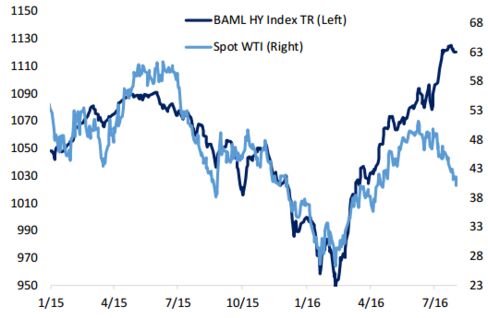
The drop in oil prices that started in the second half of 2014 was felt across high yield markets, and therefore by non-traded BDCs.  The oil and gas sector is heavily represented in the high yield debt sector, and the graph I presented my previous post illustrates how correlated oil prices and the high yield markets were until earlier this year.

BDCs are a structure, not an asset class.  Most non-BDCs operate in the large non-bank financing market, primarily making a variety of loans to small and medium sized companies.  Companies that borrow from BDCs and other non-bank lenders are generally growing companies that do not have banking relationships or cannot get bank financing, and therefore do not have investment grade credit ratings, if they have a rating at all.  This is a high yield market and comes with all the risk of high yield investing.

I have seen various numbers related to the size of the non-bank capital market, but the smallest figure I have seen is $1 trillion and the largest over $50 trillion.  This is a legitimate market that is not going away anytime soon.  Non-traded BDCs are a small part of this huge market.

Wednesday, August 03, 2016

Oil and High Yield Debt

Here is a good Bloomberg article on the rebound in high yield debt and the oil markets.  For much of the past year and a half the price of oil and high yield debt have moved together.  The latest drop in oil prices has been a solo move, as high yield debt has not followed the oil market down.  The following chart from the article shows the performance of oil and high yield debt since the start of 2015:


High yield debt market moved with oil because so many recent issuers of high yield debt were oil and gas companies.   A May 31, 2016, report by the law firm Haynes & Booth states that there have been 81 oil and gas bankruptcies since the start of 2015.

The Bloomberg article takes a closer examination of the high yield debt and oil markets.  When just the high yield debt of energy companies is compared to the price of oil, the performance is strikingly similar.  While the overall high yield market may have separated from oil, energy high yield debt is following the price of oil down.

Update:  As of August 3, 2016, the number of oil and gas bankruptcies since the start of 2015 is now up to 85.

Friday, July 29, 2016

Posting Again

It is time to start reposting.  I never formally stopped writing this blog so I am not formally restarting it.  There is a mealy-mouthed cop-out if ever there was one.

The primary reason I decided to restart posting is the DI Wire.  I have been getting its daily updates on the Direct Investment (DI) industry for a year or more and still have not figured out its mission.  Is it news?  Paid advertisement?  A mixture of both?  The best I can figure the DI Wire is mostly the PR Wire.  The tipping point for me was earlier week when a headline announced that Benefit Street was to acquire Business Development Corporation of America (BDCA).  Wrong.  As subsidiary of Benefit Street is acquiring BDCA's advisor from AR Global, and it is not acquiring BDCA.  The headline, which has not been corrected, implied a liquidity event for BDCA investors.  Wrong.  BDCA investors will have a new investment manager, not liquidity.  Big, big difference.

Of course I will continue to read the DI Wire, I love to read stories about direct investment sponsors hiring wholesalers or random acquisitions in line with investment objectives.

The Clock Is Ticking...

On July 25, 2016, UDF IV received written notice from Nasdaq Hearings Panel that Nasdaq Global Select Market will continue to list UDF IV stock.  UDF IV's stock is currently halted.  The Nasdaq decision is contingent upon UDF IV meeting certain listing requirements, in particular it has to file with the SEC 2016's first and second quarter financial statements and 2015's audited financial statements by September 12, 2016.

UDF IV's auditor resigned last November.  A new auditor, EisnerAmper, LLP, was announced on June 8, 2016, which was good news for the mortgage REIT.  The new auditor is presumably working to complete UDF IV's financial statements before the September deadline.  I expect ugly results when and if UDF IV's stock is allowed to resume trading as investors will rush to exit.  Audited financial statements or not, UDF IV remains under investigation by the FBI and SEC and is in default on a term loan that had $28.5 million outstanding as of May 23, 2016.  The following passage from UDF IV's 8-K filing describing the default shows the level of financial restrictions it faces as a result of the default:
The Trust (UDF IV) is required to use a portion of its future available cash flow to pay transaction expenses, interest due under the Loan, and principal. The Trust has agreed to provide certain financial reporting to the Lenders and it has agreed to suspend distributions to its shareholders during the Forbearance Period. The Trust also agreed not to originate new mortgage loans, incur additional debt, grant additional or substitute collateral to any other lender, or dispose of assets without first obtaining the consent of the Lenders.
 I want UDF IV to resolve its issues.  Its financial statements are at the top of my summer reading list.

Wednesday, April 29, 2015

Good Advice

Here is a Bloomberg article that quotes Colony Capital's Thomas Barrack, Jr.   Mr. Barrack provides some smart, basic advice, but advice that few people will follow.  This passage is a warning:
“Everybody is outside of their own asset class,” Barrack said in a Bloomberg Television interview Tuesday with Erik Schatzker and Stephanie Ruhle at the Milken Institute Global Conference in Beverly Hills, California. “When amateurs enter the marketplace for all of this, you are going to get an abundance of something and it is usually not good.”

Central banks globally have pushed investors into higher-yielding assets by reducing interest rates and purchasing bonds. The Standard & Poor’s 500 Index reached an all-time high on Friday and sovereign debt in Europe is trading at negative yields.

“Institutional investors that are in this endless search for yield are ignoring the risk peril of all the consequences of those things,” he said.
And here is some more:
To protect themselves from possible future losses, real estate investors should look for “equity-type returns” in the capital stack, Barrack said during the panel discussion.

“Floating debt can choke and kill you quickly,” he said.
The article is about real estate investors, but you can substitute nearly any asset class that throws of yield and uses low cost leverage to boost returns. 

InvenTrust

Inland American changed its name to InvenTrust Properties Corp on April 16, 2015.  I would have posted earlier but I am still laughing at this nonsense name.  Inland needs to invent some equity for Inland American investors rather than waste time and money thinking of a made-up name.   The new logo is cool, although I am not sure what it signifies.


InvenTrust's spin-off of Xenia Hotels and Resorts (XHR) has held up well in the market since its listing in February.  It has traded over $22 per share since mid-March.  Inland has had more good news, as its latest non-traded REIT, Inland Real Estate Income Trust, raised over $88 million in March, placing it third out of all non-traded REITs in sales.  Not too shabby.

Friday, March 27, 2015

Tedious

The lazy reporting on non-traded REITs is getting tedious.  Few journalists that write articles about non-traded REITs fully understand them, and it shows.  The latest installment is from the March 24, 2015, Wall Street Journal, in an article titled "Property Investors' Latest Horror: Zombie REITs."  The article focuses on two pre-crash REITs, and not all the liquidity events over the past two years.  The article's focus was Inland American and CNL Lifestyle, two REITs I have recently posted about.  There is no way to spin the poor performance of these two REITs, but they are not the entire market, and their struggles are not new news. 

The article states that the value of Inland American's holdings has plunged 60%.  Wrong.  This is based on the $10.00 per share price that investors paid for their shares and the recently announced $4.00 per share value.  The difference between the original $10.00 per share and current estimate of $4.00 per share is indeed 60%, but it excludes the value of the Xenia Hotels & Resorts (XHR) spin-off that all Inland American investors received.  I figure the listing of XHR was worth approximately $2.80 per share to Inland American investors, or 28% or their original investment (and XHR stock has gone up since its listing).  The article mentions XHR, but not the amount returned to investors.  The amount investors received in XHR needs to be added to Inland American's remaining value.  Inland American still has its issues and investors are still at a loss, but the XHR listing was a major event.

The article further states (my emphasis):
Fundraising by nontraded REITs has now cooled. The funds pulled in about $15 billion in 2014, down by a quarter from 2013, in part because the funds returned just $12.9 billion of investors’ original capital last year, down from $17.2 billion in the previous year.
My own research showed $13.5 billion of original equity experienced liquidity events in 2014, not $12.9 billion.  If you use the WSJ numbers, in two years there was over $30 billion of liquidity.  If you look back at the lack of liquidity in the '80s, '90s, and '00s, $30 billion of capital returned to investors in a two-year span is stunning.

(There is more than a small irony that the article complains about 2014's drop in fund raising for non-traded REITs due to the decline in liquidity events.  Selling a REIT upon its liquidity event to reinvest in another non-traded REIT is a story in itself and a bigger industry-wide issue than two well-known, struggling REITs.)

Journalists and business publications have to get better covering and understanding non-traded REITs (and their sort of brethren business development companies).  These investments have raised billions since 2008, and to sound alarms and recyle old themes without addressing current issues is not helping investors.  The only thing missing from this article was as a Leo Wells reference.

Tuesday, March 24, 2015

Return for Risk?

As a follow-up to my post yesterday about interval funds, I encourage you to click through to view the portfolio for Ladenburg Thalmann's Alternative Strategies Fund (LTAFX).  When you finish picking up your jaw, click here to see LTAFX's returns and determine for yourself whether investors have been properly compensated (through high returns) given the risk of some of the interval fund's holdings. 

Oil Storage Problem

Bloomberg has an article and animated video on its website that present a scenario where oil could go to $20 a barrel or lower if oil storage reaches capacity.  The article is full of hypothetical situations, but it reinforces my feeling that no one knows where the price of oil is headed.

Monday, March 23, 2015

High Priced Mediocracy

Interval funds - generally, continuously offered closed-end funds - give investors a chance to invest in multiple alternative investments they may not otherwise qualify for directly.  I am specifically discussing interval funds that focus on acquiring interests in business development companies, public REITs, private REITs, private equity real estate funds, private placements, and public, non-traded REITs.  These interval funds are similar to mutual funds, so suitability requirements are much lower than a direct investment into one of the non-traded investments owned by the interval fund. 

My knocks on interval funds are fees and performance.  Interval funds are funds-of-funds.  This means there are two layers of fees - one at the interval fund level and one at the underlying investment fund level.  The combined annual expenses can run three percent to five percent of total assets, which is a big hurdle for asset classes and investments - real estate and business development companies - that are historically income oriented, not growth focused.  Funds-of-funds will have average performance, as top performing funds' results are offset by the results from poor performing funds.  Over the long-term, for most investors, I don't believe the portfolio benefits of an interval fund - diversification and lower volatility - outweigh the performance issue, which is inherent because of interval funds' structures, and diminished further by their high fees.

Thursday, March 19, 2015

Growing Glut

I am fascinated by the drop in oil prices.  No one predicted the price drop of the past six months.  No one knows if oil prices are going to $80 a barrel or $20 a barrel.  (There are guesses at both ends of the spectrum, so some analyst will be able to claim prescience.)  The attached Bloomberg article and the chart below are from last week but give an indication of where prices are likely to go, at least in the near term.


Friday, March 13, 2015

Bad Guess

Last week I guessed at a price of $6.50 per share for CNL Lifestyle's new net asset value.  I was not close, not even in the same county close.  In an 8-K filing on March 10, 2015, CNL Lifestyle disclosed a new NAV estimate of $5.20 per share, down 24% from the $6.85 per share estimate at the end of 2013.  Read the 8-K, the candor of certain statements is jarring, like the following passages that help explain why the REIT's NAV dropped from $6.85 per share to $5.20 in one year:
Based on discussions between Jefferies and more than 150 potential buyers over the course of the last year, the Company has determined that the value of its assets is lower than the NAV per share of common stock as of December 31, 2013 (the “2013 NAV”). This price discovery data was not available in prior valuations and represents the most significant factor in the decrease of the 2014 NAV from the 2013 NAV. 
Another factor driving the reduction of the 2014 NAV was portfolio performance that, in certain instances, did not meet the Company’s, its operators’ or CBRE’s forecasts. 
CNL Lifestyle's investment banker, Jefferies, shopped the REIT and its assets to more than 150 potential buyers and was told that the $6.86 per share price was too high ("price discovery").  In addition, the assumptions (i.e. net operating income, cap rates, etc.) the REIT used to determine value in early 2014 were too optimistic.  This REIT purchased plenty of niche assets during a real estate boom, so you can't play revisionist today, but a near halving of value is still ugly.

Thursday, March 05, 2015

Wrong On Many Levels

I am hearing some crazy things about American Realty Capital Properties (ARCP), Cole, and RCS Capital (RCAP).  The rumors and finger pointing are flying around so fast someone is going to lose an eye.  Then I read a blog post on an advisor rumor website (I am not going to link to it) that is so wrong it would be laughable if it was not scary.  The post is essentially long quotes from several broker dealer analysts upset by changes at Cole Capital.  The problem is that the article flips back-and-forth, confusing ARCP, which owns Cole Capital, and RCAP, which owns broker dealers and distributes AR Capital-sponsored alternative investments, and treats the two companies as one entity.  If we have learned anything over the past four months it is that ARCP (and Cole) and RCAP are separate companies.  If you are going to spread rumors, at least get the companies straight.

Tuesday, March 03, 2015

Head's Up

CNL Lifestyle REIT announced (warned) today that it is disclosing its net asset value per share on March 10, 2014.  I can hardly wait.  Lifestyle's NAV last year was $6.85 per share.  In 2014, Lifestyle sold its golf properties and used most of the proceeds to pay off mortgage debt related to the golf properties and pay down the REIT's line of credit.  Lifestyle has not returned any capital to investors from property sales.  Lifestyle is still planning on completing its liquidation by December 31, 2015, according to its third quarter 2014 10-Q.  At what share price do we set the over/under for the new NAV?   I'll guess $6.50 per share.

Monday, March 02, 2015

The Wait Is Finally Over

American Realty Capital Properties, Inc. (ARCP) filed its restated financial statements this morning, which stem from the October 29, 2014, disclosure of accounting errors .  The restatement includes the first two quarters of 2014, and full years 2013, 2012, and 2011.  According to this Bloomberg article, which quotes a JP Morgan analyst, it does not appear that any bigger issues emerged from the restatements.  The specter of some undisclosed issue at ARCP was the concern of most people who follow the non-traded REIT industry.  The restatement did result in ARCP reporting an increased loss and lower adjusted funds from operations for 2013.